At a Glance: RV LIFE Podcast Episode
Explore off-grid camping in New Brunswick, where dark skies, horse camping, ATV trails, caving, and zip-lining replace the usual resort amenities. Learn how payload, axle ratings, tongue weight, and real-world loading determine whether a truck can safely tow a trailer. You’ll also hear how Park With Us grew from an RV frustration into software serving hundreds of campgrounds. And get a closer look at the new 2026 RV LIFE Trailer Towing Guide.
If you tow your RV—or you’re shopping for a new truck or trailer—this episode could help you avoid one of the most common and costly mistakes RV owners make. Don’t rely on the manufacturer’s tow rating alone. Discover why that number is only part of the equation, and how payload and axle ratings often become the real limiting factors. Learn why adding airbags doesn’t increase your truck’s legal carrying capacity, and why weighing your fully loaded rig is the only way to know if your setup is truly safe.
The episode also takes you to a very different kind of campground in New Brunswick, where RVers trade hookups for dark skies, forest trails, rock climbing, caving, ATV riding, and even horse camping. You’ll then hear how frustration with outdated campground reservation systems inspired two RVers to build a campground management platform from inside their RV that now serves hundreds of parks across North America.
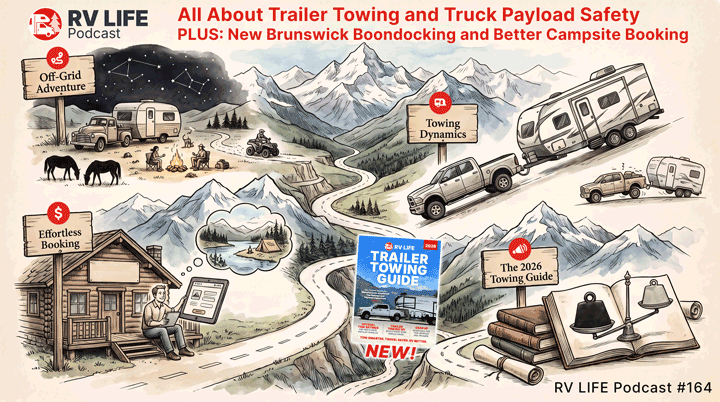
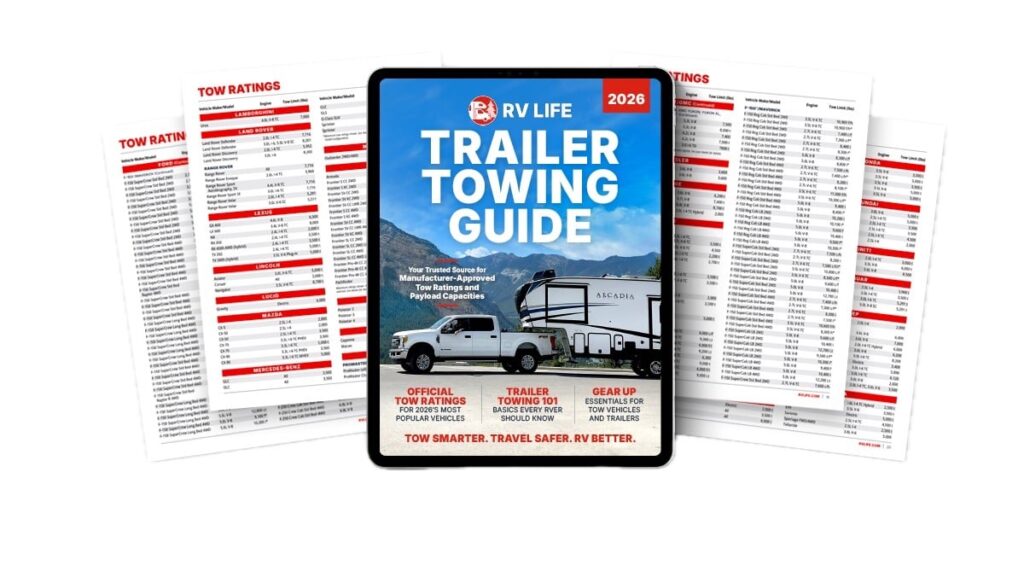
Finally, we take a look at the new 2026 RV LIFE Trailer Towing Guide. This updated guide now includes payload capacity figures alongside tow ratings to help shoppers understand what a truck can safely carry, not just what it can pull. Whether you’re new to towing or have years of experience, episode #164 of the RV LIFE Podcast offers practical information that can help you travel more safely and make better buying decisions.


All About Trailer Towing, New Brunswick Boondocking & Better Campsite Booking
Top Reasons to Listen Now
- Travel: Discover an off-grid New Brunswick campground with dark skies, horse camping, ATV trails, rock climbing, caving, and zip-lining.
- Lifestyle: Learn how tow ratings, payload, axle limits, hitch weight, and weight distribution affect truck and trailer safety.
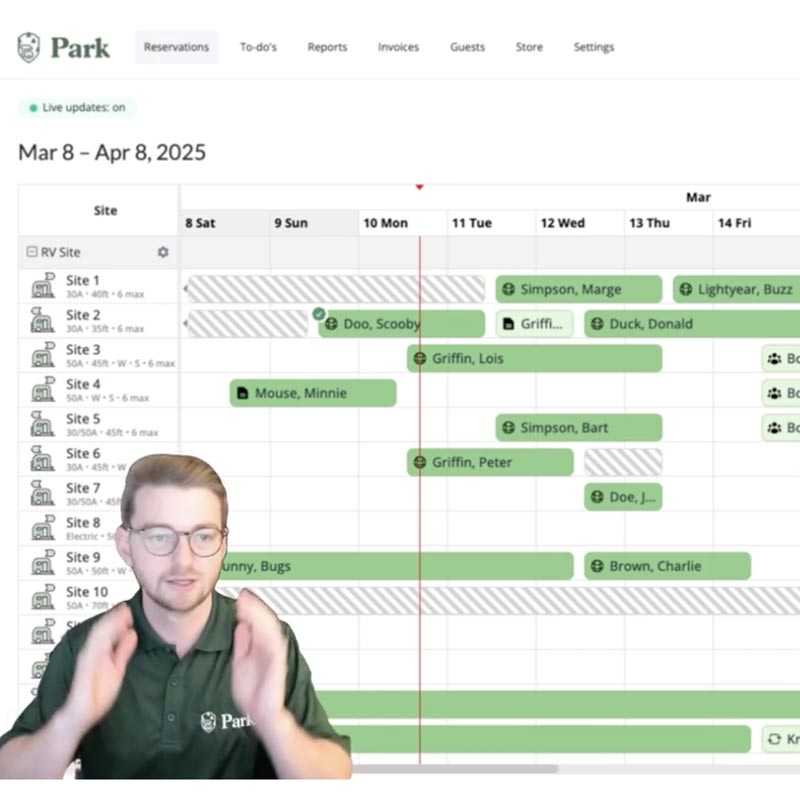
- The RV Entrepreneur: Hear how Rylan Blowers turned a frustrating campground booking experience into software used by more than 600 parks.
- News: Get a closer look at the 2026 RV LIFE Trailer Towing Guide and why its new payload information matters to RV and truck buyers.
RESOURCES MENTIONED
- Salma Burney
- Trey Selman
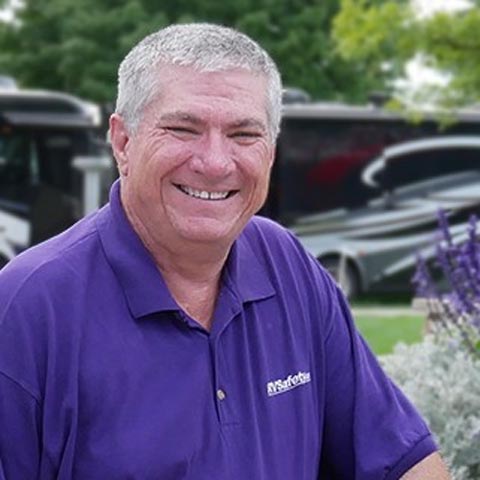
- Rylan Blowers
- Kris Bunker

Be A Guest or Share Your Story!
https://podcast.rvlife.com/contact
Listen to the RV LIFE Podcast Episode #164
Listen and subscribe to The RV LIFE Podcast on Spotify or in your favorite podcast app. Or, read the full episode transcript below. Leave a comment, or contact us with any questions or feedback.
Connect & Learn More
- https://podcast.rvlife.com/about
- https://facebook.com/rvlifepodcast/
- https://instagram.com/rvlifepodcast/
- https://www.facebook.com/groups/rvlifemovement
Got a great story or tips to share with listeners? Leave us a voice message!
(NOTE: Audio submitted may be published on the podcast unless specifically requested otherwise.)
All About Trailer Towing, New Brunswick Boondocking & Better Campsite Booking
RV LIFE Podcast Episode #164 Full Transcript
RENE: You know, I’ll bet every RVER has a few subjects that make their eyes glaze over a little bit.
JIM: And towing capacity numbers are probably right at the top of that list.
RENE: Exactly. Payload, tow rating, tongue weight, pin weight, gross combined weight. It can sound like alphabet soup until you realize those numbers are what keeps your trip safe.
JIM: And that is why this episode is so special. Welcome to the RV Life podcast. I’m Jim.
RENE: And I’m Rene. Consider this our towing episode. We’re excited about it because RV Life has just released our newest RV life trailer towing guide.
JIM: If you tow a travel trailer, fifth wheel, or toy hauler, or you’re shopping for a truck or trailer this year, this is one of those resources you’ll want to have before you buy, before you load up, and definitely before you hit the road.
RENE: Bob talks with our own Kris Bunker from RV Life about the brand new 2026 trailer towing guide and why this year’s guide puts even more focus on payload.
JIM: And we talk with Trey Selman from the RV Safety and Education Foundation about matching the right truck to the right trailer, why tow ratings don’t tell you the whole story and why payload is often the number that catches people offguard. So definitely stay tuned.
RENE: But first we have a travel segment from John about a very different kind of camping in New Brunswick, Canada. Think offgrid dark skies, horses, ATVs, and a campground where unplugging is the whole point.
JIM: And Rose and Glynn talk with RV entrepreneur Ryland Blowers, co-founder of Park with Us about building campground software from an RV and turning one traveler’s frustration into a platform now used by hundreds of parks.
RENE: So, yeah, we’re talking adventure, business, technology, and off-grid camping. But the heart of this episode is towing safely and understanding what your rig can really handle.
JIM: So, let’s get started. First up, John is taking us back to New Brunswick.
RENE: And not just to any old campground with full hookups, paved sights, and pickle ball courts.
JIM: Nope. This one is for you off-grid RVers who want peace and quiet, darkness, trees, stars, and maybe a little adventure mixed in.
RENE: John talks with Salma Bernie from Offgrid Adventure in New Brunswick, Canada. This rustic campground is near Fundy National Park where campers can unplug, stargaze, rock climb, zipline, go caving, ride ATVs, or even camp with their horses.
JIM: Here’s John with Salma.
JOHN: Thanks everyone and welcome once again to the RV Life podcast. My name is John DiPietro. This is the travel section and normally when we do a travel section, we give you a destination, somewhere that you can travel to and do your traditional RV things, you know, like tourist places and, you know, some of the major features of the campground. But today, we are taking you back to Canada where we’ve been for a couple weeks, our second trip to New Brunswick and we’re talking with our friend Salma Bernie from offgridadventure.ca. Offgrid adventure. And Salma, your park is totally different and it is an unplugged park and the logo, you know, the cutline that you use is unplug to unleash the adventurer in you. First of all, welcome back to the RV Life podcast and tell us what makes your park special.
SALMA: Thank you, John. Yes. So, what makes our park special is we are, like you said, an unplugged to unleash. We are a back to nature campground. So, you’re not going to come here and plug in your water, your septic. You’re actually living in some tree area. But the nice thing is for people that have trucks or trailers, you pull in, you actually can pull in in between some trees. You have a lot of that area. We’re unique that we’re also a dark sky location. So,
JOHN: What does that mean?
SALMA: Well, a dark sky location means those that like to look at stars and actually see the star without all the light from the city.
JOHN: Yes.
SALMA: So when it comes to stargazing there is a what do they call it a ban from 1 to 5; 1 is the darkest place and that would be places like Death Valley, certain plates, and then 4 and 5 are a lot of your towns because there are a lot of lights and so there’s light pollution so you can’t see certain stars. You can see some but not a lot. You wouldn’t be able to see the Milky Way. When you get our places between it’s at a 2 to a 1. So, it’s getting pretty dark. And it’s great where you can actually see things like I can see Jupiter, Mars when they’re out with my bare eye, the star itself. I don’t even have to look outside. I can be in my house looking out my window because it’s so dark. And it gives it’s a great place then because they do say the light pollution actually causes some people not to feel like get a deep sleep because you’re not really totally in a dark space.
JOHN: Yeah. So Salma, I made a very basic error in introducing you because I didn’t ask you where is the park located. First of all tell us where New Brunswick is in relation to the rest of the US and then zero it down to where you are in New Brunswick.
SALMA: All right. So, in the US, you have the state of Maine. New Brunswick borders on the state of Maine. And for your Americans, just a little known fact, when you cross into New Brunswick, you’re actually crossing into a new time zone. It is now the Atlantic time zone. So, in Maine is an eastern time zone. And New Brunswick, Nova Scotia, and Prince Edward Island, we’re all in the Atlantic time zone. And then there was another one in Canada. So we actually have two more compared to the states from the border. If we’re calling like the Calais St. Stephen border, we’re a 2-hour drive. You would be it’s the drive that you would take if you were going to go to Moncton or Prince Edward Island. So we’re right off the highway.
JOHN: Eastern part of the southeastern part.
SALMA: Yeah, southeastern. We are on a little town called Anagance and we are
JOHN: You’re not arrogant. You’re not arrogant.
SALMA: We’re not arrogant. We’re Anagance. We’re actually 30 minutes from Fundy National Park where a lot of people go to see the Bay of Fundy. That’s where the water goes from every
JOHN: Yeah.
SALMA: So we’re exactly 30 minutes away from Fundy National Park.
JOHN: Is that the same What was the same tides? Is that called reversing tides?
SALMA: No. The reversing falls and tides as in St. John.
JOHN: Okay.
SALMA: Yes.
JOHN: But similar concept with the lower level being up and down.
SALMA: Well, the reversing one basically instead of it going in a circular, it will go the opposite way.
JOHN: Okay.
SALMA: Whereas the Bay of Fundy, the tides go all the way down. So you can walk on the bottom of the bay and then in six hours based on the tides it goes up. Oh, yeah. You have to go up quickly. It goes up and then there’s stairs that go down and you’ll see the water come up and you can’t go on those stairs anymore. It’s quite cool.
JOHN: So, the website says rock climbing, caving, ziplining, and horse park. Now, you don’t offer like trail rides or anything like that, but if people have their own horse
SALMA: Yeah. So, what makes us different is we’re the only place in New Brunswick where you can go camping with your horse. So that means if you’re a horse owner and you wanted to go on different trails, we do have trails for horse owners to go on. But if you’re also traveling through to either Nova Scotia or PEI, you can stop and you can actually let your horses out. We have nice 10×10 box stalls. We also have paddocks for the horses to roam in and stretch their legs and then we have pull-through sites for the people with their what they call LQ living quarter trailers to park and rest in. And while they’re not and then the horse owners they can use our indoor arena. So we have a 60×80 indoor arena. We also have a 100×200 outdoor arena as well. We have a barn with that and we have the only obstacle trail that goes through our forest.
JOHN: Wow. Wild. Wild. Now, as far as ATVs are concerned, can you bring yours there? And are there trails that go through the park that you can access right nearby?
SALMA: Yes. So, we are also ATV friendly. And what we like to also educate the ATVers is all of our trails are shared trails. So, if there’s horse riders on the trail and ATVs, you know, you need to learn how to share the trail from our location. You can just go from the top of our property and that connects to the Petitcodiac trailblazers and so there’s the trails there and from the south part you can go through the Sussex ATV trails. So, and in New Brunswick if you are coming on any of the ATV trails you do have to have a trail pass which you can get from Quad New Brunswick.
JOHN: Okay. So, in this particular case, we’re not going to find tennis courts. We’re not going to find a camp store. We’re not going to find pickle ball courts. We’re not going to find a, you know, that type of thing. But if you show up in a traditional either motor home or travel trailer that’s self-contained and park there for the duration, whatever, whatever you want. My guess is that you are going to hear some major league silence at night.
SALMA: Generally, yes, we do back onto we’re parallel to the highway and train tracks. So, you might get a little highway noise depending, you know, which way the wind blows and you might hear a whistle from the train, but generally it’s quite quiet. When people come in a motor home or an RV, we do have flat spaces for them to park in. We do have a washroom cabin which uses collected rainwater and there is two toilets, a hot water on demand shower, a kitchen sink and a bathroom sink for everybody to use. Like you said, there isn’t tennis courts, but what we do have is an adventure park that has a zipline. It has an outdoor rock climbing wall. We do horseshoe pit and then we have the only indoor rock climbing caving cabin where it’s
JOHN: I was going to ask you this play and stay cabin that you call
SALMA: That’s what it is. Yep. Because you can play. There’s three walls are all different rock climbing holds and behind the walls you can actually cave behind the walls with the headlamp and then the floor is two layers of mattresses covered with carpet. So it’s nice and bouncy. So we say to the kids, “Look, you can bounce on the bed and you’re not going to get in trouble.” And for parents, there’s only one door, so you don’t have to worry about losing any kids.
JOHN: One door. Yeah. One of the good thought, good marketing idea. So tell us website and about availability during and are you open year round?
SALMA: Yes.
JOHN: So if you’re in a snowmobiling environment, you can tow up to there and go from there.
SALMA: Yes. Yes. Find us. It’s offgridadventure.com.
JOHN: Singular.
SALMA: Singular.
JOHN: Don’t folks make the same mistake I made and put down .com. offgridadventure.
SALMA: Correct. We are on exit 223 off of Highway 1 and Anagance is spelled A N A G A N C E in New Brunswick. Our phone number is 506-688-2831. We are also on Facebook and Instagram. And we are open pretty much year round. In the winter time, it is what we call dry camping. So that means you’re not going to have water inside your trailer because you don’t want your pipes to freeze. But we do things a little bit differently out here, too. So, and spring and fall is a great time to come because in the springtime we don’t have as many bugs. It’s not as hot and then the fall it’s the fall colors out here. Our autumns are wonderful. People come to look for we have tons of trees out here. We have actually apple trees. So there’s lots of different apple trees and different activities in and around our area as well.
JOHN: Cool. Well, Salma, we want to thank you so much, ladies and gentlemen. This is something that’s totally different. So, if you’re looking for a destination, well, actually, you are a destination or it’s a stop off when you’re going to the other cities in New Brunswick or PEI or even heading down to Nova Scotia from there. So, we want to thank you so much for joining us. This is the RV Life podcast. My name is John DiPietro. Thank you for being with us.
RENE: I love how different that is from the usual campground conversation. No hookups, no lights, no overbuilt resort feel, just trees, dark skies, and space to breathe.
JIM: And camping with your horse, I bet the neighbors are pretty friendly there.
RENE: Yeah, that really shows you how diverse this RV lifestyle is. Some people want a luxury resort, and some people want a dark sky, a quiet night, and somewhere their horse can stretch their legs.
JIM: That’s the beauty of the RV life. You can find it all. Now, let’s shift gears into the main topic of this episode, towing.
RENE: This is one of those things we can’t talk about enough, especially for new RVers or anybody thinking about changing trucks or trailers.
JIM: Now, we’ve been towing for a long time, and I’ll admit, GVW, GTW, GVWR, all these numbers can still make my brain want to hit the rest stop.
RENE: Oh my gosh. Same here. But Trey Selman has a way of making this easier to understand. He’s the executive director of the RV Safety and Education Foundation, and his job is helping RVers understand weight, safety, and how to operate their rigs responsibly.
JIM: In this conversation, we talk about truck and trailer matching, tow ratings, payload, airbags, weight distribution, hitches, and that my truck can pull it all is not the same as my truck can safely carry it.
RENE: Here’s our conversation with Trey Selman.
RENE: Trey, welcome back. Thank you so much for joining us again.
TREY: Nice to be here. Thank you very much.
RENE: You’re very welcome. Let’s start at the very beginning here. You know, when someone is new to towing, what should come first if they have the if they’re fortunate enough to start from scratch, would someone want to choose the truck or choose the trailer? You know, do you get the truck or the trailer first and why?
TREY: That’s a great question. Many times there’s not a should necessarily. I mean, that’s a great question and I don’t mean to correct the question. That’s not what I’m saying. It’s just different people’s situations. Way back in the day when we first started, we tried to see what could we tow with the tow vehicle that we had, right? We already owned it. So, let’s see what we can do. And we realized real quickly that we were going to try to full-time in this. And that was not going to work. So then it changed and then it became well, let’s just see what kind of trailer would be good to function and then we’ll get the truck that needs to tow.
JIM: That makes sense.
TREY: Again, it’s just kind of a situation, you know, what everybody’s situation is and they might have to adjust that as they learn.
JIM: So new buyers should consider how they’re going to live. I know our dealer when we first bought our first RV said, “Buy your second RV first because no one ever comes back and buys a smaller RV.” We were fortunate, we were in an unfortunate enough situation where we had to buy a truck first. So, we had a truck that we had to get a trailer within the specs for, but if you have the liberty of time and money and all the money in the world, sounds like look at how you’re going to live and get the living space first and then buy a truck that’s going to be compatible and suitable for that,
TREY: Especially if that’s really critical for you. I mean, you know, and again, it comes back to how are we going to RV? Are we just going to go out for, you know, we do we’re just so wide in what we do with an RV. So, it really just depends that if you’re going to full-time in it, then you really need to think about that. You know, what’s going to make you comfortable. If you’re just going to go out for the weekends, you know, take family out for the weekends, then there’s more flexibility there sometimes to make adjustments.
RENE: Totally. You know, Some people might have said, “Well, maybe that RV salesperson was trying to just sell you a more expensive rig.” But, I’m glad he told us that because we went in there with the intention of just getting like a little 20ft trailer or just a small rig and he was very good and we got a 24 foot. But, I’m glad we did because I think as new full-timers, we would have killed each other in a smaller rig. That was 18 years ago. We’ve learned a lot since, but You know, we were newbies once and I feel very fortunate that we got a really good truck. We got a 2500 and the 25 foot fifth wheel. Worked out great. What are some of the common mistakes that you see people make when they’re matching a truck to a trailer?
TREY: Not getting a large enough truck. That’s the problem. It’s surprising what we really need to be able to carry that weight. There’s two things when it comes to towing. One is being able to move all that weight or mass around the country over the mountains through the wind. And then the other is how much weight can it hold? How much weight can it bear? Because there are weightbearing components that can fail. Often that’s where the problem is. Technology has been so great with engines and transmissions and gearing that the mass can be moved, but it’s truck sizes vary greatly. And that’s how much weight can be loaded on the truck. And that’s what really gets people because it could, you know, you could have a certain type of truck that can move that much mass, but it can’t carry the weight whenever you load the trailer on the back.
RENE: So, when we’re looking at our truck or we’re considering a new truck, hopefully people are paying attention to those specs versus, you know, the payload capacity versus the towing capacity. But why do published tow ratings for vehicles often give RV buyers a false sense of security? I mean, they think they see that number and they think, “Oh, that’s fine. I just need to be within that number.”
TREY: That’s based on only one number. A tow rating, if we want to just focus on that one first. The tow rating there are two main issues. One is it’s focused on just being able to move the mass across the country. That’s the primary focus of that and that’s a number also. The second thing with regards to that is that tow ratings are. It’s not that manufacturers, truck or SUV manufacturers are being dishonest. They’re not. They’re trying to make it simple or make it easier for us to do this. But we need to understand that they’re setting up that vehicle when they determine that tow rating or the gross combined weight rating when they’re setting it up the way that they set it up. I mean, it’s the way that we set it up and we put more stuff on it in reality. And so that really that tow rating is in the best possible scenario if you set up your tow vehicle as they did which basically has very little in it and very few options as well. It has some options but not very many. And so that’s where the trick and the problem comes sometimes is that those numbers look really good from a marketing standpoint but when it comes to reality we can’t really carry that much weight.
RENE: So that general tow rating is how much the vehicle can pull versus how much it can carry and carry in the bed or on the tongue.
TREY: Yes, that’s correct. It’s focusing more on there are three primary ratings on a tow vehicle and one of them is the gross combined weight rating and the tow rating is built off of that gross combined weight rating. And then so that has to do with moving the mass and then the other ones are the gross vehicle weight rating and the gross axle weight rating. And that’s how much weight can be loaded onto the vehicle and we don’t want to go over those. And that’s usually where the problem ends up coming is that we’re putting tongue weight or pin weight, which is the weight of the trailer that’s not being carried by the axles and we’re putting that on the truck. And that’s a big heavy thing sometimes. I mean, that’s into hundreds to thousands of pounds. And that’s a lot of stuff that’s being loaded on the back of that truck and it overloads the truck.
JIM: Is that what happens when you see somebody’s rear end really sagging? Does that automatically say that they’re overloaded?
TREY: It’s probably a good guess. You know, it’d be a good guess. Yeah. When it’s sagging and the nose is up high, then we’ve got an issue. Now, you know, until you measure something, we’re a firm believer in guessing is not a good thing. Measuring is a great thing. You know, measure get a scale weight. You can find some of this stuff out with just a cat scale weight and get a lot of that information, especially on a tow vehicle because you can on a cat scale. There are multiple platforms and you can weigh the front axle and the rear axle and see what’s going on on both of those and then the whole vehicle. So measuring is an easy and inexpensive way to be able to check things out.
RENE: So we have airbags on our truck and I’m always noticing the sag and some of them get serious when they have those big rigs on other trucks that have a real low bed and their front end’s up in the air. Is airbags a band-aid? It helps with the position of the truck, the leveling of the truck, but it’s not going to help with the carrying capacity, is it? How do airbags come into play when you’re looking at those numbers?
TREY: Yeah, airbags are always a controversial subject sometime when we get into things like this. Because it seems like that would help the situation. But airbags, the way they function, they help in the sense that it does level the truck, but it doesn’t really help redistribute weight. What really helps redistribute weight is a weight distribution hitch. It functions differently with the dynamics of the vehicle and it helps shift weight from the rear axle to the front axle. Airbags don’t do that. They just make it ride a little bit more level and may make the ride a little more comfortable. But in reality, if you’re trying to get more capacity with an airbag, that’s not possible. What it actually does is it makes things worse when you get technical about it. Because when you’ve overloaded the rear axle or the tow vehicle. That means you don’t want to put anything else on it. Well, when you put an airbag on it, what have you just done? You’ve added, Granted, it’s not a lot of weight, but you’ve added something there. And I’m not saying not to get airbags. I don’t mean that. I mean, airbags have their place in their function. They help with ride comfort. They help with leveling a little bit. But if you really want to deal with weight and a problem with weight, it’s either redistributing the weight by moving things around or in many cases, especially with a travel trailer, you could get a weight distribution hitch and that can help greatly.
JIM: So, the airbags, I’m a fan of them. They sound like they can really help, but they might also provide a false sense of security because while it looks and feels better, you’re still going to have that weight.
TREY: Yeah. You haven’t really moved weight off of the rear axle and that’s where the problem is. And so, when you haven’t moved weight off of the rear axle, then you also are offloading the front axle and that makes maneuverability a problem and so it doesn’t address that situation. Whereas a weight distribution hitch does address that situation. It helps to shift weight from the rear axle to the front axle through these spring bars that are back there. And that helps to deal with an overloaded rear end especially on travel trailers.
RENE: So what about fifth wheels and airbags? Would all of this apply minus the weight distribution hitch?
TREY: As far as how the interaction happens on a fifth wheel, it’s a little bit different because where the connection happens. So the connection on a travel trailer happens behind the bumper and so that rear axle kind of becomes like a I call it playground physics, right? We’re on a seesaw and so that becomes that pivot point the rear axle and so it can push the back end down and lift the front end up. On a fifth wheel when you connect it you’re connecting it right over or maybe even more ideally a few inches in front of the rear axle and that doesn’t offload the front. It actually hopefully puts maybe just a smidge bit of weight on the front and that keeps it more evenly distributed. So, you don’t really have that offloading that you do with a travel trailer.
JIM: That’s good to know. We better pay attention to that now that we’re travel trailer owners. Now, I’m gonna be honest with you, Trey. The numbers that or the acronyms I should say that we have to look at as RVers have always made me zone out. GVW, GVWR, GCVW, all of these. It’s an alphabet soup to me. Can you explain it in lay person terms? What are the most important acronyms that we need to know when we are trying to match the two vehicles, the trailer and the truck?
TREY: Sure. There’s three of them and they’re on both the truck and the trailer and one of them is only on the truck and that’s the gross combined weight rating. So when you have a truck and a trailer attached together, that’s called a combination vehicle. So that’s where that word combined comes from. And it has to all of them have to do with the maximum allowable weight that can be put on that loaded vehicle. So it’s the maximum allowable weight that’s set by the manufacturer and it’s on a loaded vehicle. So you don’t want to go over that once you load it up. And so then the three different numbers talk about three different areas. So the gross combined weight rating talks about moving the mass across the country, so it focuses on the engine, the transmission, and the differential or the gears in the back. So that’s moving the mass. Then the GVWR, which V stands for vehicle, so that’s going to be on the truck and the trailer and that’s just once you load it up don’t go over that number. That’s kind of the simple easy definition for all of them really: once you load it up don’t go over this number. Or as Gandalf said, “You shall not pass.” Right? Okay. So, that’s kind of what we’re looking at. And then the GAWR is just an axle assembly. So, it’s those axles that are underneath our vehicle because that’s where all that weight goes from the frame down to the ground. And so, that’s really a big part of that weight carrying capability. And when we get these big heavy RVs on there, the axles become important.
RENE: And that’s where it becomes important to understand the individual weight weighing that we discussed in the previous episode. Listeners, check out the show notes to get that one. But what about contents? We all have too much stuff, right? I mean, does payload capacity, that’s yet another number there. Does that become the hidden limiting factor for many RVers? How does that differ if you’re loading the bed of a truck, pulling a trailer, or loading up a fifth wheel?
TREY: Payload capacity. I like to use the term that’s a little bit more descriptive that really means basically the same thing is cargo carrying capacity, right?
RENE: Okay.
TREY: And that’s based off of the as we talked earlier about tow capacity being based off of the gross combined weight rating. The cargo capacity or the payload is based off of the GVWR. So remember that GVWR is you don’t want to go over once you load it up, don’t go over this weight. And so what the payload is or the cargo carrying capacity is once all the options are put on that vehicle, it’s weighed at the end of the manufacturing line. And so that’s called the unloaded vehicle weight. And it includes certain things or not certain things depending on what kind of vehicle it is. But that’s an unloaded vehicle weight. And so you subtract that unloaded vehicle I’m doing math now, right?
RENE: Keep going. This is important.
TREY: But you subtract that unloaded vehicle weight from the GVWR and that’s the payload or the cargo carrying capacity. So that how much stuff you can put on it before it goes over the GVWR. So, that’s really important. And quite frankly, when it comes to towing, often from a statistical standpoint, that’s the one that’s usually overloaded first. It’s not always true. I mean, there’s always unique situations, right? Especially in RV because we have so many different types of RVs and they’re built differently. But that’s the one that often gets overloaded first is the GVWR because we’re putting too much stuff on that vehicle.
JIM: You know, the light bulbs coming on. I don’t know if you saw it flickering over my head, but this is all starting to make sense. We’ve been RVing a long time and I’m still learning. So, I really really appreciate you explaining all this. If somebody out there listening is brand new and they’re shopping, what is the basic rule of thumb you’d give them to avoid getting into trouble later on with maybe a mismatched combination?
TREY: You need to study. I mean, you really need to understand it a little bit and to not be too silly, but we don’t want to take that lightly.
RENE: Little pun play word lightly.
TREY: So, you don’t have to laugh too hard, but I mean just understanding it. There’s so many times where we weigh vehicles and people weigh their rigs and they just don’t have enough truck to be able to do it or SUV, whatever the vehicle is, and it’s overloaded. Sometimes if it’s just a little bit, like you mentioned earlier, Jim, we can manage that. But when it gets to a certain point, there’s only one way to fix that and you have to get a smaller trailer or get a bigger truck, you know? So, we’re back to what the dealer told you, their second RV, right? Or you just have risk that you’re taking with not only with you, but with other people that are traveling around you. And so, that’s something that we need to be aware of. So, learning about it and trying to understand it is important. And you’re right, Rene, the numbers can sometimes put you to sleep. But I always say it’s a thrilling subject area, that and tires, all edge of the seat kind of stuff, you know. So, come to one of our classes. We really try to make it fun as best we possibly can. So, certainly please try to do that.
RENE: I encourage everyone to do that. And I remember long ago I heard you can never have too much truck. Is that true? Can you ever have a truck that’s too big for what you’re pulling?
TREY: Yeah. Let me try to answer it this way. Whenever we realized way back when you asked the first question and I kind of said we had to figure out what we wanted to live in, right? It was a 40 foot fifth wheel, which is a lot bigger than what you decided you could live in, right?
JIM: Yeah.
TREY: So then we started looking at how much that was going to cost to buy a truck to do that. And it was going to be pretty expensive truck, big truck, dually. And so we ended up getting a semi-truck. So we pretty much got the biggest truck you can get to be able to do that. And then we put a smart car on the back of it. And so that’s how we lived with a big semi tractor and a smart car. So I say it doesn’t hurt to have way more truck than you need, but you know it can cost. But I say that too is that it was half the cost to get that semi-truck than it was to buy a dually pickup truck.
JIM: Wow, that’s something to consider. I’m always in awe when I see those combinations go by. That’s pretty cool.
TREY: Yeah.
RENE: Well, Trey, I can’t thank you enough. I’ve been wanting to meet you for so long, and Jim and I are going to make an effort to get to one of the in-person classes and seminars that you guys have because it’s so educational. You can’t ever not learn enough if you are towing, no matter how long you’ve been RVing. So, really want to thank you for being here and educating us.
TREY: You bet. Thank you for giving me the opportunity. Appreciate it.
RENE: Very welcome. And thanks to you again.
TREY: Take care.
JIM: That’s one of those conversations where the more Trey explained it, the more confident you can feel behind the wheel.
RENE: Oh, good. The big takeaway for me was how towing safety isn’t just about the biggest number in the brochure.
JIM: Exactly. Tow rating matters, but so does payload, axle ratings, cargo, passengers, hitch weight, and how you actually load the rig makes a difference. And I appreciated what he said about measuring instead of guessing. We all think we know what we’re carrying until we actually weigh the truck and the trailer at each wheel.
RENE: Can we take a break from towing for a minute to let that all sink in?
JIM: Oh, sure. Before we get to Bob and the new RV life trailer towing guide, Rose and Glynn have a really interesting RV entrepreneur profile.
RENE: This one is about a problem almost every RVER has dealt with, finding and booking a campground without all those phone calls, emails, text messages, confusion, or outdated systems.
JIM: We meet Ryland Blowers, who helped build Park with Us. After experiencing that frustration himself while on the road, he started coding from his RV during the pandemic, and the platform has grown into campground management software used by hundreds of parks.
RENE: I love stories like this because it starts with a real RV problem, not some boardroom idea, but an actual “why is this so hard” moment from someone living the lifestyle.
JIM: Here are Rose and Glynn with Ryland Blowers from Park with Us.
ROSE: Welcome back to the RV entrepreneur segment of the RV Life podcast. I’m Rose and Glynn is here with me as usual. And today we have Ryland Blowers, co-founder of Park with Us, a campground management platform, which is always free for parks to use. And he coded this right out of his RV during the pandemic. And today, his software serves over 500 RV parks worldwide. Wow. So Ryland, welcome to the show.
RYLAN: Thank you so much for having me, Glynn and Rose. It’s great to meet you both and yeah, excited to chat a little bit more about our journey from the early days of coding out of my RV to now getting to run a 15 person business and having over 50,000 campsites that we’re managing on the platform. It’s been the adventure of a lifetime.
GLYNN: Yeah, I am so curious to hear this story. Ryland, you built a tech startup and it seems incredibly tough for someone who is not in that industry and also doing it from your RV during a pandemic is wild. So, take us back to the beginning. What was the specific frustration on the road that made you realize that campgrounds desperately needed this?
RYLAN: Yeah, absolutely. I’ll take you through the Genesis, which very much started with scratching our own itch. And we all have different things that probably frustrate us on the road. For me, as at the time a 25-year-old, new RVER, the thing that frustrated me was to email and call for a space that I was going into for the night. If I can book someone’s house on Airbnb without needing to go through the rigmarole of all that, I shouldn’t need to do that for plugging my self-contained house into their site. And so started very much from being personally frustrated and at the time there was significantly less coverage with online booking. And I was driving with my now co-founder who being an incredible engineer. I am a subpar engineer but he, being himself said, “Let’s build it. That sounds great.” And I said, “All right, slow down. Let’s get some validation.” And that night, we pulled into a mom and pop campground, which is to this day really our bread and butter in Western Texas, and pitched them on the idea. They said, “That sounds amazing.” As you alluded to, really what makes this different is that it’s incredibly easy to use for the campgrounds, for the campers themselves. They should be able to book in 60 seconds or less on the highway. And then it’s free for parks that we do get to work with and the service fees that we pass to the guests are optional in so far as they can always still call and show up and do it that way. So that was kind of the natural genesis and from there it quickly grew and now yeah as as you alluded work with a ton of fantastic operations across the country.
GLYNN: That’s an exciting journey. I mean you know RVing is about adventure but you took this adventure a whole different direction. Now let’s back up a second because you talked about pitching this to that first campground and being an entrepreneur myself, I remember that lack of credibility in the very beginning. And how do you overcome that obstacle of being, okay, we’re here we are just two guys and we can solve your problem, but we can’t show you any proof that we have.
RYLAN: Yeah, that’s very fair. I think a lot of credibility comes from your ability to uniquely speak to the problem. So, if it’s really is scratching your own itch and something you have a unique insight on in this case, obviously being an RVER and feeling that frustration and having the skills to solve that frustration. We were able to come out of the gate probably a little bit stronger than if it was just something we had a wild hunch on. But in terms of how that process actually looked like, we stayed up all night that first night building an MVP that wasn’t even really working, but it was just enough to bring and show. The next day we got that kind of first park onboarded. And so it was like start to finish I think a 16-hour validation; truly we didn’t even stop for one moment to do any amount of market research and I always thank my blessings for that because I think if we did we never would have started this company because there is a lot of folks that are out there and there’s companies that are doing this and we probably would have said “Okay, someone’s already done this on to the next idea.” But I think the ability to put through and just make sure you’re improving the bar and solving the frustrations in this case of the campgrounds that dominate the states and keeping that as a northstar. That that’s what allowed us to be.
GLYNN: For sure. And improving the bar and you guys clearly didn’t suffer from paralysis through analysis. And it also sounds like one of the key takeaways here is that you both had so much passion and conviction for what you were, the itch that you were trying to scratch that it was a no-brainer for the campground to accept your proposal.
RYLAN: Yeah, definitely. And you asked about what was our frustration, but what surprised us is that actually we found that they were even more frustrated because everything was either far too expensive or far too complex or combination of the two. And so for businesses that, oftentimes don’t have two nickels to rub together, giving them a solution that doesn’t create backbreaking costs and their 86-year-old mother-in-law can understand was really the secret sauce. And something that, not only for the campgrounds and businesses we work with, but we also take super seriously when we think about what is the camper experience. And obviously relevant to those that are listening to this podcast is we need to make sure that you can get through this. You don’t need a 50-inch screen. You can book I truly I shouldn’t promote booking while you’re on the highway, but when I was RVing, I was booking on the highway for that night. And that should be a simple process, not a dangerous one. And so that’s something we take super seriously. The interface that you get to use as a camper, as a campground, is incredibly straightforward and delightful.
GLYNN: Yeah, that’s exciting. And I appreciate the fact that you’re putting the consumer first and thinking it from the perspective of how they perceive things and the customer service side. If you ever listen to this podcast, I am Mr. Customer Service, period. So, I appreciate that.
ROSE: Hold up. I want to back up to this. I’m going to play dumb now. You make this free for the campgrounds to use. How does that work? You know, how are you creating profit for yourself?
RYLAN: Yeah. That’s the I think it would be easier if we charged a little bit because people don’t trust it. But the way it works is really, and this is from the get-go, we realized we needed to do something that worked for the small and medium businesses that really dominate the landscape of our industry, and don’t have anything that suits them. And so, from the get-go, we knew we couldn’t be charging them crazy monthly subscription fees. And so the way it works is that it’s always free for the park, no matter what. No setup fees, no upsells. And we do that by passing a small service fee to any guests that choose to book online or choose to pay their rent online. You get the convenience of that. But the really important thing that I want to double down on is that it’s always optional. Let’s say, you’ve stayed at the same park for years and you’re used to calling them up and you give them a check when you show up. That’s great. You shouldn’t be penalized for that. And so there’s no service fee in that case. But for the younger campers, or the folks that prefer to book online. talking to myself I am more than happy to pay that convenience fee, book directly, know I’m good for the night. I can get off the highway. And in doing so have created really a win-win-win for everyone involved. Including of course the businesses that we work with directly.
GLYNN: Well you make it easy for them to do business with you and you make it easy for the consumer to do business with you.
RYLAN: Yeah.
GLYNN: Give everyone kind of a choice and optionality and then
RYLAN: Yeah. Make it a no-brainer. That is super important to us. And why would you ever leave if everyone wins?
GLYNN: Exactly. Exactly. Now, let’s look at sort of because you describe your team as a mix of outdoor enthusiasts and nerds. Being a closet nerd myself, what is your strategy for recruiting and finding the best top tier employees to help you build and grow this business?
RYLAN: Yeah, the trick is to find someone that’s both a nerd and an outdoor enthusiast. But I feel very grateful that we’re able to build in an industry that is at the cross-section of profession and passion. So many people are so passionate about the outdoors, including I would assume the listeners here. And so in our case, we’re able to kind of start from a point of passion and then back into the right skill set. So the majority of our team members, we’ve actually found through an outdoor newsletter, which might be of interest to anyone listening that’s looking for roles. It’s called Base Camp Outdoors and it’s basically folks that are enthusiastic about the outdoors, put up listings there and then we know that they’re default super excited about working in this world and then obviously like I said work backwards to skills that we need and we really need incredible team players to be able to continue to operate at the speed we are but we all share this commonality and it makes building a team feel incredibly light and makes running a business feel incredibly light and that’s something that we really try to maintain as we continue to grow outside of the RV.
GLYNN: For sure. And you know what? And because of that passion, it means that you’re probably going to hold on to these employees for a long time.
RYLAN: So far so good. 100% retention. Five years.
ROSE: Fingers crossed for you, Ryland.
GLYNN: Well, this all sounds wonderful. Like everything came together so nicely and perfectly and easily maybe, but as we all know as entrepreneurs and starting businesses, I want to know about these challenges or little issues you may have had, especially in the beginning like coding from your RV during a pandemic. Like anything that you can think of that would help kind of shed some light on these challenges.
RYLAN: Yeah. I mean, everyone that’s done or considering the path of entrepreneurship knows that you are choosing the hard path. It’s a very rewarding one, but I mean every day is difficult in its own way. I struggle to find exact points that feel acutely painful. I mean there’s always things that going on with someone messes up their electric billing and actually earlier today we’re trying to unwind because they accidentally billed twice on the same invoice. So there’s kind of acute points like that that are just the day-to-day that you need to get through. I would say the fact that we’ve kept things kind of feeling light and that way there’s not contracts, there’s not a customer churn and there’s not that’s really helped us mitigate some of the more existential macro-level pain. But I think the biggest thing is just, business is very hard if you’re not growing enough because then you’re scared and the future’s not certain. Or if you’re growing very quickly, it’s almost just as painful. It’s more acutely painful. And so we’ve gone through these kind of cycles of whoa, we can’t keep up. We feel like we’re drowning with a very good problem to have. And then we need to make sure we can afford to scale up the team. And so it’s honestly just a fact of the matter of keeping up with the demand is kind of the most painful areas. And then, we add a couple people and we’re good again. So, that’s kind of the ebb and flow of business that I’ve had to discover over the last five years.
ROSE: Yes. All normal natural processes of building a business.
GLYNN: We know that world.
ROSE: Yes. And wait, so you’re in more than 500 parks, correct?
RYLAN: Yes. I think we just crossed over 600.
ROSE: 600. Well, congratulations. That is really cool. And so, you’re not in an RV full-time anymore. You’ve had to transition into living in a sticks and bricks location. So, how do you market now? Because before it was easy, you could just go to the parks.
RYLAN: Yeah, I am a land lover now. So, you’ve outed me. And that was more just out of a life circumstance. But, in terms of kind of how our marketing has changed, obviously, yes, in the beginning it was knocking on doors, calling while I’m driving down Highway 66 and seeing who would listen to my crazy pitch. Which I’m very grateful that’s how we got our roots and so much of what we’ve built has been shaped by that. But today we’re very lucky that our business is inbound. So people are coming to us whether it’s through word of mouth or because we’ve put out an advertisement somewhere on the internet and got in front of someone that we think is a good candidate that they say “You know what this is a pain point let’s go set up a call.” So thankfully yeah we get to be operating from position of people wanting to talk to us rather than, you know, calling and emailing a thousand people a day until someone begrudgingly takes a meeting. And so because of that, we’ve been able to do that without needing that kind of face-to-face channel and just being remote first, whether it’s with our employees or how we interface with the customers they work with and then the campers that are using it directly. I think, just building with that remote first mentality has been key to that and that transition off the wheels into the sticks and bricks.
ROSE: Off the wheels. Well, don’t lose that mentality, the remote first. I like that.
GLYNN: So, Ryland, where do you see Park with us and the campground technology industry as a whole heading in the next five years?
RYLAN: Yeah, it’s an interesting question because I think we’re all thinking about the scary unknown of AI and what is the world going to look like in five years and that’s all anyone’s talking about. And it’s honestly pretty exhausting and many times people are trying to camp and go outdoors to get away from that. So I think the obvious question as a software company is like something in the AI realm but I think the subconscious and underlying piece there is that people want to avoid that and you know you do want to interface with the friendly camp host that you’ve been to for years and so I think finding that balance is really delicate and really really important. So I think that looks like building these tools that give people the option without the requirement in the same way that we’ve done that with the service fees. And so I think it’ll be more affecting the campground tools to help them run their business and run a good business and get their name out there. And then for the campers, you still have just as much control and flexibility. But if you want to use this AI road trip planner to build your dream road trip and share with your family and it’s powerful for you, great, you can. But I think always having it as an option and not a requirement is kind of the balance that we need to draw as we enter the unknown and enter the AI-driven world while still doing what we do best which is getting people outdoors in nature with their families and keeping that as the Northstar.
GLYNN: Yeah, you had us at getting people outside with families. Good call. Very good call.
ROSE: With everything we’ve talked about so far, is there anything that we didn’t talk about today as far as scaling your business or how you operate? Or just anything about Park with us that we should have mentioned for our listeners.
RYLAN: Yeah. No, I appreciate that. I think it’s a really exciting time for us because we’ve been so heads down just working with campgrounds themselves and building with their needs in mind and now we get the opportunity to look at the other angle which is the actual camper and the consumer side. And that’s where we started. But it’s now that we’re a handful of five years removed, I often forget about that perspective. And so now that we’re really thinking about that and wrapping our heads around that whole, we’d love to get your listeners involved, have them use the tools, make sure it’s valuable, and just really provide a holistic solution from the beginning to the end of the camping kind of experience. That’s something that we’re really emphatic about providing that to everyone and making sure technology is enabling that. So I think that would be the one piece and then the other piece that is kind of interesting is all the other use cases that we do get to work with. So, when you said for the next 5 years, I think it’s not just campgrounds, but there’s also camping that has other adjacent things like marinas and boats or fairgrounds that have RV sites, or they do floats and white water rafting. So, there’s all these kind of ancillary pieces that have also been traditionally pretty difficult to book and find slots for. And we’re seeing more and more interest in those. So, I would say for any listeners that are out there that, either know or operate a business that are in the camping and camping adjacent industries. We’re really trying to build something that’s flexible for whatever your business looks like.
GLYNN: Excellent. I love that. Everyone involved.
ROSE: Yes. Well, there’s no shortage of a need for other applications at all. So, I think you nailed a very important point that when you do perfect something, look outside that and see how you can apply what you perfected to other avenues.
RYLAN: That is certainly the goal. Easier said than done, but that is what keeps us up every night.
GLYNN: So, Ryland, where can listeners go to learn more about Park with us or schedule a demo for their own property?
RYLAN: Yeah. So, if they have their own property, go to parkwith.us and you’ll be able to see a demo of how the software works. What makes it simple and free and set up a time with one of our team members. But more than likely, you’re a consumer. So, I would love for you to go to parkwith.roadtrips. That’s where you can describe your dream road trip. It’ll pick out all the best points of interest that are within striking distance of your route. Any campground to stay at, of course, ones that we support, but also actually other campgrounds where we want to be just a perfect tool that’s agnostic and it’s also free. So I think there are road trip planners that are out there. They all come with a subscription cost because they have to be able to make some money somehow. In our case, we get to promote our own campgrounds and in doing so, we don’t need to charge the consumers anything. So, this will be completely free to use to plan to figure out your dream road trip. And then on the back end, if you’re booking, great. We appreciate the support that you provide to our campgrounds. But that’s how we’re planning to offer that. So, that would be my main call to action to anyone that’s listening and thinking about their next cross country trip, local trip, whatever that looks like.
GLYNN: Brilliant.
ROSE: Brilliant. That’ll be all in the show notes as well. So, Ryland, we want to thank you again for coming on today. Kind of pulling back the curtain on your business for our listeners here. So, yeah, we appreciate your time. Thank you.
RYLAN: Thank you, Glynn. Thank you so much. Appreciate it.
JIM: I love how Ryland started by scratching his own itch. That’s such a great way to describe a business that solves a real problem.
RENE: And I like that they built it to be simple for both sides. The campground has to be able to use it, and the camper has to be able to book without jumping through hoops.
JIM: And that’s the kind of technology I can get behind. Useful, easy, and not trying to make RVing any more complicated than it already is.
RENE: Speaking of complicated, let’s make RVing simple for everybody and their towing trailers.
JIM: Right back to towing.
RENE: The newest RV Life trailer towing guide is out. And Bob is talking with Kris Bunker, RV Life’s senior content editor.
JIM: Kris has been covering the RV industry for more than 25 years, including towing guides for Trailer Life and Motor Home magazine. So, when he talks about towing safety and weight ratings, he’s bringing a lot of experience to the table.
RENE: And this year’s guide adds payload information. This is huge because payload is one of those numbers RVers most often overlook.
JIM: And as Kris explains, that can be the limiting factor long before you hit the published tow rating.
RENE: Here’s Bob with RV Life’s Kris Bunker.
BOB: All right, welcome back to our podcast this morning. My guest this morning is Kris Bunker. And Kris, you are now the senior content editor for RV Life, part of our RV Life family. And tell us a little bit about your background and what you do and why you’re in that position.
KRIS: Well, I’ve been in the RV industry for longer than I’d like to admit, but about 25 years. And what I do now is I work with RV Life. I work with the content department with RV Life. And what we do is we do blogs. We make sure that our messaging is clear along the lines of our products. And I’m also heavily involved in the guides. And today we happen to be talking about the towing guide.
BOB: There’s
KRIS: So the
BOB: So the there’s also the dinghy guide. We’re working on some other things that are pretty exciting for the future.
BOB: Stop there for a second. Tell folks a lot of people may be listening and they don’t they may not even know what a dinghy is. What’s
KRIS: That’s a great question. Dinghies are also called toads. And when you see a motor home that is towing a passenger vehicle or a smaller truck or an SUV, that’s a dinghy vehicle. And there are several ways that you can tow a dinghy vehicle. But a true dinghy vehicle is four wheels down, meaning there’s no trailer involved. It is a hitch from the or a toe bar from the motor home to a base plate that is added to the dinghy vehicle itself. And not all vehicles are dinghy towable. There’s only a handful of vehicles, as a matter of fact, that are dinghy towable without best case scenario without voiding the warranty. Worst case scenario, without totaling the transmission, the truck, everything else or the car, everything else because they’re not designed to roll without something being engaged.
BOB: That’s a good point. But the thrust of the trailer towing guide is for people who are doing towables and understanding the importance of what we like to call in the industry weight management and payload. And you added a new feature this year with the payloads. So talk about the rating system but also you know why did you add the payload this year?
KRIS: Well we added payload because the tow rating is the major part in the equation, right? That is what can this truck or this SUV tow? But payload is another very, very important part of that equation and quite frankly it’s the main number that gets ignored and it gets ignored pretty frequently. Maximum tow rating is what the truck or SUV can tow. It’s what it can pull. Okay? Payload tells you what that same vehicle can carry. And there’s a very important distinction. When you’re towing a trailer, your truck is actually carrying a lot more weight than you might realize. You’ve got passengers, cargo, pets, tools, hitch hardware, and anything that’s added to that truck. And then when you’re towing a trailer, with a travel trailer, you have what’s called hitch weight or tongue weight. With a fifth wheel, you have what’s called pin weight. That’s a percentage of weight from the trailer that is actually being carried by your tow vehicle. All of that counts against the payload. Okay. So, we decided to add payload because a lot of times payload can be the limiting factor for towing before the tow rating. A tow vehicle can be well within its towing tow rating limit but actually be over payload. Now, what does that mean? Hey, being over payload affects handling. It affects longevity. It affects durability. Most importantly, it affects safety. If you’re overtaxing these components, there could be a dangerous towing situation that would affect you, that would affect your family, whoever’s with you, and that would also affect people on the roads, and we do not want that to happen. Now, when you’re driving on a road and you see an RV, or a lot of people when they see an RV, they think, “Oh boy, here we go.” Maybe RVers don’t have a great reputation, and I don’t believe that’s warranted at all. However, staying within these ratings ensures that you’re having the safest, most comfortable towing situation and it keeps everybody around you safe and comfortable as well. There’s no, you know, you don’t see the trailer swaying quite so much. You don’t see people going back and forth in the lanes. It’s just important for comfort. And again, like I say, we’re all about safety. And these ratings are put in place for a reason. And just because you can exceed a rating, a payload rating or a tow rating. We would never recommend that. We never will recommend that. Stay within those limits. Keep everybody safe, happy, and on the road.
BOB: Yep. When we look at it from an industry standpoint, I think the most important part of the publication that you’ve done, like you say, for almost 25 years. You did it when you were at Trailer Life. You did it when you were at Motor Home. The most important part is education. And we as an industry have to do a better part. So RV Life is taking a good leadership role as you’ve done for 25 years. And I wish our dealers would do more. Dealers should have classes on payload, on weight management, on what a truck can seriously tow or an SUV, what you can and cannot do. Not because it makes them feel good. It should be an educational tool that the consumer and if you’re the person that educates the consumer on the safety fees, that allow them to drive down the road and feel comfortable with their rig, feel comfortable about the RV lifestyle, they’re going to come back and do business with you. And that’s why this guide, which they say has been out there for so many years, I look forward to it every year. And it’s always on my desk. It’s always at my seminars. I always bring it up in the seminars because people have to know and we have too many people buying and using RVs who have not been taught the importance of weight management.
KRIS: Right. Right. And again, you touched on a good point. When you go to a dealership, a lot of times the question is, “Oh, you know, I have a trailer that weighs this much. Will this truck tow it?” Yes, absolutely. No problem. You know, if it falls within the maximum tow rating, of course it will. But again, we go back to you can, but should you? And the answer is no, because you have to take into consideration trailers aren’t, let’s start with the trailers. You don’t camp with a dry weight. You don’t camp with a dry trailer. Your trailer has fluids, it has tanks, it has propane, it has hopefully it has comfort items like food, water, things like that. So already your dry weight is out the window. Dry weights are tools. Dry weights are a starting point. A lot of these weights are a starting point. So you have a ballpark figure, but you know, once you get into the actual act of RVing, you realize that there’s a lot more that goes into it than what’s in the brochure. There’s certainly a lot more that goes into it than what the sales person told you, “Yes, that can tow that.” I mean, you got to remember like payload is what you can carry. Okay? Towing an RV right off the bat eats up a lot of that payload because you have a trailer, a travel trailer, that’s 10 to 12% of that travel trailer’s weight rides on the truck.
BOB: Well, you know, between
KRIS: Yeah.
BOB: The other thing is when we don’t educate people the right way and we have newbies that buy their first trailer or their first fifth wheel or first motor home, they look at all the story and say, “Look at all the stuff I can take with me.” Fair and great point. If nobody ever leaves the driveway, you know, because we haven’t told them, and if you make them bigger, they take more stuff with them.
KRIS: Right. Right. Yeah. And this towing guide, that’s a great point. This towing guide, again, these numbers are a basis to start the conversation. Now, they’re set in stone, but you take a look at these numbers. So, from again, when you have a towing guide, that includes the new vehicles. Like this is 2026 vehicles. Okay. So, what we’re trying to do is get people who are shopping for a truck. Maybe they already have a trailer, maybe they’re considering a trailer, but these are starting points. And unfortunately, we don’t even get into packing and load and weight management in that aspect apart from some of the supplemental stories that are included. Now, we do our best to cover those things, but that’s a whole other guide, Bob. That’s quite a bit of information. And what we’re trying to do is we’re trying to take what we feel are the two most important parts of the RV towing experience, tow rating and payload. Can my truck tow it? Will my truck safely tow it? We actually believe that that is the more important question is can my truck or SUV in, some cases, can it do its part? Can it carry its part of the equation? So I have a safe and confident trip down the road without having to worry about can it stop? You know, stopping distances increase exponentially as soon as you connect a trailer to your tow vehicle. So, everything is tested and again, these numbers are set in stone. We recently ran a story about “Can I increase my vehicle’s tow rating?” No, you cannot. You cannot. You can upgrade components. You can make things feel more comfortable. You can do all these things. You cannot change a manufacturer designated tow rating. You certainly can’t change a payload because payload is specific to each individual vehicle.
BOB: Yep. Yep. And this the 2026 RV life trailer towing guide goes a long way to doing that and does it excellently and hopefully everybody downloads it, prints it out, keeps it in the vehicle, takes it to the dealership when they go. Our guest today has been senior editor for RV Life, Kris Bunker. Kris, truly enjoyable to have you take time out on this day to join us on the RV Life podcast and always happy to be a part of the RV Life team. And anything you any closing comments for our fans before you head out for the holiday weekend?
KRIS: Well, I just one thing really quick and obviously safety is at the forefront. So if there’s one thing that I would ask RVers to do to make sure that everything’s okay is get your truck and trailer or get your motor home, load it up how you would travel. And I’m talking about everything, the dog, the whole crew, soaps and sodas, we used to say, everything. Get it weighed. Take it to a cat scale. Go to catscale.com. There’s a location module there. Find the nearest one to you. Take it to that cat scale. Weigh everything you can. If they kick you out, go back and weigh again. It’s 20 bucks. That $20 goes a long way toward not only comfort, but also safety for yourself and for others. So, that’s one thing that I really think needs to be done more.
BOB: Yep. Yep. And again, that’s part of the dealer responsibility. That’s part of the education. And the pilot truck stops have scales also.
KRIS: Correct.
BOB: And some of the Loves are starting to as well. So there, you can all there’s recycle centers.
KRIS: Right. Right.
BOB: There are places, you know, everybody just put weights “cat scale near me” and see what comes up. Kris, thanks for joining us today. We’ll see you down the road.
KRIS: Sounds great. Thanks so much, Bob. Appreciate it.
JIM: That guide needs to be in front of every RVER who’s shopping for a tow vehicle or trailer.
RENE: And every salesperson, too.
JIM: Absolutely. Because when Kris said there’s a lot more that goes into towing than what’s in the brochure, that’s the whole point.
RENE: The brochure might tell you what a truck can pull. But real life adds real people. Pets, gear, hitch, hardware, water, tools, food, and everything else we convince ourselves we need.
JIM: And all of that weight adds up.
RENE: That’s why the new RV life trailer towing guide matters. It gives RVers a smarter starting point before they buy or tow. Download it now at rvlife.com/towing2026.
JIM: This wasn’t all about towing, but I do hope this gets people talking, weighing their rigs, checking their numbers, and asking better questions before the next trip. We also got to explore off-grid camping in New Brunswick. Hear how one RV frustration became a campground software company. And learn why dark skies, simple camping, and safer towing all have something in common.
RENE: That’s right. They all make RVing simple when we slow down and do things the right way.
JIM: You can find links to connect with all of our guests and get that towing guide on the episode page at podcast.rvlife.com.
RENE: And if this episode made your eyes cross a little bit, don’t worry. You don’t have to memorize every towing acronym today.
JIM: Just start with the basics. Know your tow rating. Know your payload. Know what your trailer actually weighs. And get the whole setup weighed before you assume everything is fine.
RENE: That’s what the new RV life trailer towing guide is for. To keep you, your family, and everyone else out there safer on the road.
JIM: Thanks for joining us for another ride on the RV Life podcast. We’ll see you next time.
RENE: Happy travels, folks. And if you’re tempted to shrug off payload because it sounds like just another heavy topic, just remember
KRIS: We don’t want to take that lightly.
RV LIFE: Bid farewell to the stress of travel planning with RV Life Trip Wizard. This feature allows you to customize your routes, avoid potential hazards, and even discover the best campgrounds based on real user reviews. It’s not just about reaching your destination. It’s about enjoying the journey. And with RV Life Trip Wizard, every journey is effortless. Learn more about this game-changing feature at rvlife.com.
FAQs About RV LIFE Podcast Episode
Off Grid Adventure offers rustic camping without hookups near Fundy National Park. Guests can enjoy dark skies, horse camping, ATV trails, rock climbing, caving, zip-lining, and a shared washroom cabin with collected rainwater.
Tow rating reflects how much mass a vehicle can pull. Payload is how much weight the vehicle can carry, including passengers, cargo, pets, hitch hardware, tongue weight, or fifth-wheel pin weight.
Park With Us is campground management and booking software co-founded by Rylan Blowers. It’s free for campgrounds, with optional service fees for guests who choose to make reservations or payments online.
The new guide includes payload information alongside tow ratings. This helps buyers compare not only what a truck can pull, but also what it can safely carry once people, gear, hitch weight, and trailer weight are added.
The RV LIFE Podcast is presented by RV LIFE – Tools that Make RVing Simple
https://rvlife.com