
At a Glance: Real Winter RVing Worries And Wins
This winter edition of the RV LIFE Podcast covers what cold weather really does to your RV, from hidden road salt damage and frozen plumbing to power drain and winter camping realities. You’ll hear expert advice on protecting your rig after winter driving, and practical cold-weather camping lessons from years of experience. Plus get a real-world look at building an app-based business on the road, and how the RV industry is introducing new travelers to the RV lifestyle.
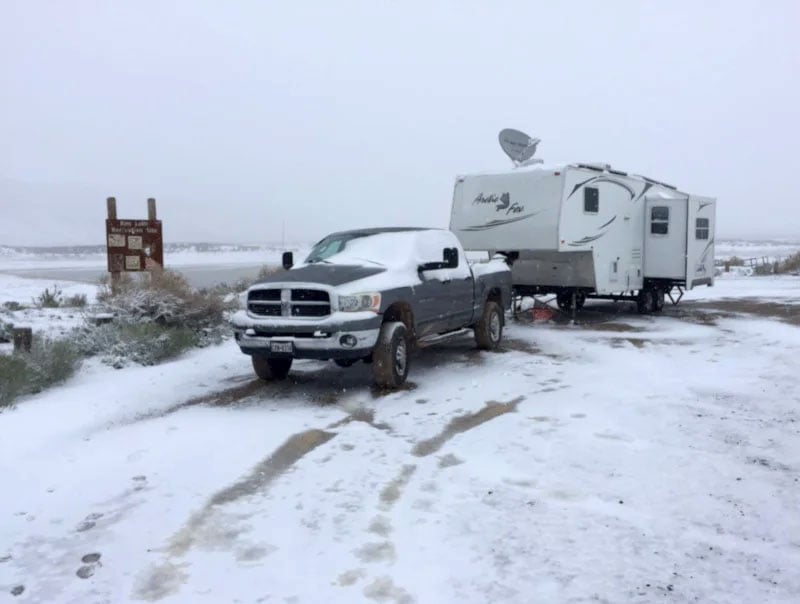
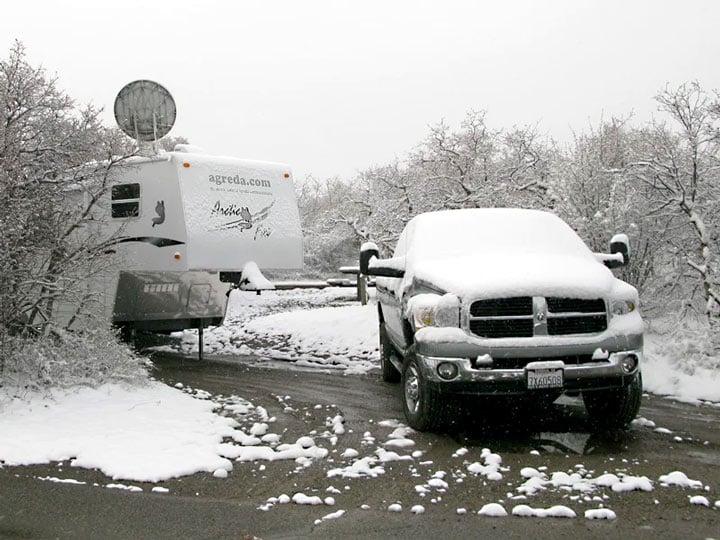
Winter RV travel looks magical until your rig rolls through brine, your hose freezes solid, and your batteries tap out before sunrise. With RV LIFE Podcast episode #152, we unpack the cold-weather playbook you actually need: how road chemicals and salt corrode wiring, frames, and leveling pistons, and the simple rinse routine that saves you thousands. You’ll hear how to protect exposed components after a storm drive, where to focus undercarriage cleaning, and which coatings buy long-term peace of mind.
Then we get hands-on with cold camping: why furnaces drain 12V fast, how lithium shines and when it can’t be charged, and the small habits that keep water moving and pipes warm. We talk about heated hoses versus onboard tanks, the right way to avoid the 25-foot ice snake, and using cabinet airflow, thermostats, and water heaters to guard your plumbing. We also dig into skirting that truly works, smart site selection in wind and sun, and safer space heaters that won’t stress RV wiring.
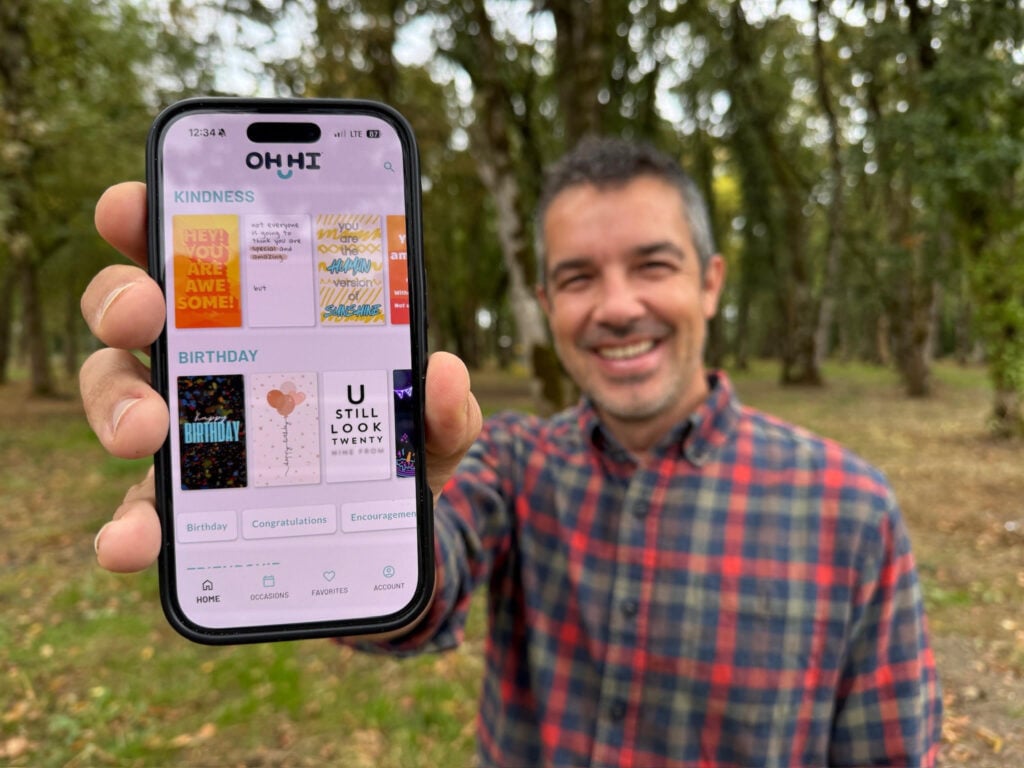
Next, we take an entrepreneurial deep dive with Alex Haldeman, creator of the OhHi app, who shares the good, the bad, and the ugly truth about building an app-based business on the road. Hear candid lessons on costs, bandwidth hurdles, learning curves, and why building anything new means tackling “a thousand small problems.”
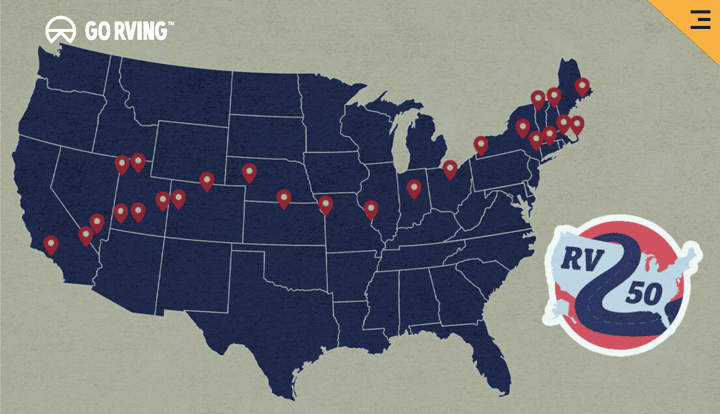
Wrapping up with RV industry news, we explore Go RVing’s experiential marketing that’s bringing RVs where crowds don’t usually expect them. And discover the RV 250 passport celebrating America’s 250th with shareable routes, journaling, and real incentives.
Whether you’re braving lake-effect snow or planning a tailgate tour, you’ll leave with practical steps to protect your rig, power your systems, and travel smarter.
Real Winter RVing Worries And Wins
Top Reasons to Listen Now
- TRAVEL: Winter road chemicals and salt can corrode wiring, frames, and leveling components. Learn how to be prepared for winter road conditions.
- LIFESTYLE: In freezing temps, water and power planning are everything. Discover how to protect vulnerable syetems to enjoy cold weather camping.
- INCOME: Hear how building an app on the road is doable, and how the process itself as part of the payoff.
- INDUSTRY: Disocver Go RVing’s experiential events and the RV 250 initiative that aims to drive 2026 RV travel momentum.
RESOURCES MENTIONED
- TRIC Mobile RV Repair
https://tricmobilervrepair.com/ - OhHi Cards App
https://www.ohhicards.com/
https://www.facebook.com/ohhi.cards - App Development
https://supabase.com/
https://flutter.dev/ - GO RVing & RV250
https://www.gorving.com/
https://www.gorving.com/rv250
Be A Guest or Share Your Story!
https://podcast.rvlife.com/contact
Listen to the RV LIFE Podcast Episode #152
Listen and subscribe to The RV LIFE Podcast on Spotify or in your favorite podcast app. Or, read the full episode transcript below. Leave a comment, or contact us with any questions or feedback.
Connect & Learn More
- https://podcast.rvlife.com/about
- https://facebook.com/rvlifepodcast/
- https://instagram.com/rvlifepodcast/
- https://www.facebook.com/groups/rvlifemovement
Got a great story or tips to share with listeners? Leave us a voice message!
(NOTE: Audio submitted may be published on the podcast unless specifically requested otherwise.)
Full Transcript: Real Winter RVing Worries And Wins
ALEX: It was one time we were in a field, and some cows kind of wandered by while I was working on the app.
RYAN: It’s kind of like a silent, blind thing that happens.
DAVE: If anything’s questionable, use the pump. It’s a it’s a warning valve.
JIM: I’m Jim.
RENE: And I’m Renee.
JIM: And you know, I think winter RVing is just so awesome. We get to head south, enjoy sunny weather while everyone is freezing up north.
RENE: Whoa. That’s not where we’re going with this episode, right?
JIM: Right, right. Okay, real winter calving can be awesome until you hit one surprise snowstorm and you come home with your RV wearing a heavy coat of road grime and nasty chemicals all over.
RENE: Or you wake up to a frozen hose and realize you’ve got a 25 foot ice snake outside your door.
JIM: Been there, done that. Today we’re talking about winter worries, cold weather, camping tips, and a smart way to keep your connections strong while on the road.
RENE: Brr! Enough already! You’re making me cold. Let’s do this.
JIM: If you’re traveling this time of year, you already know winter brings a special kind of adventure. Sometimes it’s the fun kind. Sometimes it’s the kind where you were standing outside with a hairdryer, trying to thaw something that really should never be frozen.
RENE: So this episode is all about staying ahead of cold weather problems. We want you to enjoy winter, Irving. These are the kinds of problems that you can prevent, and the ones that you can survive with a few smart habits and the right mindset.
JIM: But it’s not just about tolerable temperatures, though. Coming up, John talks with a certified RV technician, Ryan Hadley, about what road salt and chemicals can do to your rig and what to do to help prevent damage right after you drive through such winter conditions.
RENE: And then you’ll hear about our lifestyle segment with Dave Helgeson. He shares the winter camping lessons that only come from living them. Plus, we’re going to talk about practical tips to keep water, heat and power working when it’s cold.
JIM: Then, for our RV entrepreneur segment, Rose and Glenn sit down with Alex Halderman, the creator of the Ojai app. He breaks down what it really takes to build an app based business on the road.
RENE: And then Bob wraps things up with Monica Geraci from Avia talking about Gaurav’s experiential events and a new RV 250 initiative tied to America’s 250th anniversary.
JIM: All right, let’s kick off this trip with John.
RENE: Winter travel. Tip number one is simple. If the roads look wet, it might not be water.
JIM: Exactly. And not just ice either. Pretreatment chemicals and road salt can do real damage underneath your RV. You may be surprised what can happen to wiring, piping, and components you never see until something stops working.
RENE: Oh, but don’t panic. John DiPietro talks with RV Tech Ryan Hadley from Trick Mobile RV repair about what winter roads do to your RV and how to protect your rig after the drive.
JIM: Okay, here’s John with everything you need to know before heading out for some serious winter RVing.
JOHN: Hey everybody, my name is John DiPietro and I want to welcome you to this special edition of the RV Life podcast. You know, we talk about great RV destinations that people can travel to in their RV, and we certainly want to be able to do that for a long period of time. But sometimes when you travel during non-summer and spring and fall seasons, you are subject to some issues that may be coming prominent in your RV and you don’t even know about. We’re talking with Ryan Hadley. Ryan is a certified RV technician from trick RV trick RV Service in Massachusetts. Ryan’s been in the business for several years. Ryan’s also a member of the prominent group of people that have won the 40 under 40 award from RV Pro Magazine. And Ryan, what we want to talk about, first of all, we want to welcome you to the RV Life Podcast.
RYAN: Hi, John, how are you?
JOHN: Great. What we want to talk about Ryan is people that have driven or going to drive their RV from the northern climates down to either Florida or Texas or Georgia or Alabama during the winter, and have to come through an area that has been impacted by a snowstorm. Talk a little bit about the chemicals, the the adverse impact that chemicals and salts and all the other stuff that they put on the roads have on an RV that’s different than your family car.
RYAN: So it’s not only is it your your motorized RV, but also your travel trailer. There’s there’s there’s cons to taking it out in the weather that we’re having right now this time of year. They pre-treat the roads before the storms with a chemical, and then during the storms, they dump a bunch of salt on it to keep the the roads from icing up and stuff, and we all know that. And driving through that with your regular passenger car is horrible. You look at the frame and the body on your passenger car and it’s like, oh my god, and you.
JOHN: A dark car is turned white the next day when it dries up.
RYAN: Yeah. So you take your motor home and you put that going down the road. There’s not as much protection underneath the motor home, and there’s a lot more things underneath a camping trailer and a motorhome that can get affected by salt and the chemicals put down to treat the roads. You have exposed wiring, you have exposed piping, you have wiring that’s covered in sheathing and plastic and stuff. But it’s also a good way to get salt and and the chemicals into that area. And then the wires after a while will corrode and break. And then you also have all your framing around the underneath that is exposed. And that is not used to having salt and chemicals onto it. And the metals can they’re not protected as well as or they’re not protected. And they don’t have an undercarriage like your regular everyday passenger car does.
JOHN: Let me stop you for one second, because you brought up a term just just as you were beginning. You said they pre-treat the roads. Now, I have seen these tank trucks come out and drop liquid on the roads, usually the day before or several hours before a storm. I’m told that whatever that chemical is, is actually worse than salt. Have you heard the same thing?
RYAN: Yes I have. I don’t know exactly what’s in the chemical, but I’ve heard that it is worse than salt and that it’s like an instant rust inhibitor.
JOHN: Instant, instant. Okay, so you may have driven through a city or a town or an interstate highway that was pre-treated and don’t even know it, because the next day it’s dried up, but it’s still there. Residually underneath your unit. What are some things that people should be looking for to know if this is a problem? But more importantly, what are some of the things that people should be doing immediately to prevent that rust from getting started.
RYAN: Well, as far as looking at it like you might not like the day after, you’re not going to see damage starting to happen. It’s kind of like a silent, blind thing that happens. You know, you’re not going to start to see the wires corrode and stuff like that. That’ll happen over time and it could happen quickly, or it could happen over a long period of time. One of the things to prevent this is wash the camper after you’ve made a trip from the northeast area down south and you get to your destination, or you get to an area where you know that there’s no more pre-treat and the weather is warm and there’s not going to be anything on the road, it’s a good idea to to to rinse the undercarriage of the motorhome as best you can. Now, that being said, you can’t just drive into a regular, everyday car wash. Ernie’s car wash and say wash my motorhome. You have to find a specific area. I know there’s some truck washes that’ll do undercarriage washes, but if you don’t have that option, there is other options, homemade options that you can do. And I know you and I had talked about this before, John, and you said that you’ve used this?
JOHN: Yes I have.
RYAN: You take a sprinkler and you do. You drive the vehicle over it or do you just take the sprinkler?
JOHN: What I’ve done is I have the I have the vehicle parked in the driveway, and I have the sprinkler up at one end, usually where the motor is, and then the hose goes all the way around to the back end, and I turn it on and then pull it back slowly so the water goes up into all those cracks and crevices. Um, you know, and I’ve had very good luck with it. But the thing is, it’s very easy to forget, because if you’ve if you’ve cleaned your outside and when you said rinse it down, you mean just hose it down or mean scrub the areas? Um, not necessarily scrub it, but at least use a towel or some type of soft bristle brush.
RYAN: On the frame itself. You’re not going to. I mean, you could take a soft bristle brush and go against the frame. That would definitely help it out even more. And then what? You could do even more advances once you’re done doing what you do. As far as taking the sprinkler, you could hook your, um, your sprayer back up and go around to the suspension area where it looks like, you know, there’s crevices where salt and rust. Salt and sand can sit in there and cause rust.
JOHN: In the wheel wells. Right?
RYAN: Yeah. In the wheel wells in, like, the leaf spring hangers and all the areas that once you get rust started, it’s hard to stop it. Yeah.
JOHN: Okay. A lot of people a lot of times you don’t think of this, but your leveling system, if you’ve got that, that road salt and stone and sand up in it, that there’s some corrosion issues there which would, um, make them inoperable, right?
RYAN: Yeah. If you have if your leveling system is exposed, which every leveling system is exposed, but if you have your pistons exposed to any harmful weather, whether it be salt or the chemicals or anything, those can start to start eating away at the piston over time. And what can happen is if you get little burrs and stuff on the on the cylinder for the leveling system, that can eat away at your seals, and it can cause a chain reaction of damage that will happen over time.
JOHN: And that’s not, if not hundreds of thousands of dollars to, uh, to remedy to replace those.
RYAN: No, you’re talking, you know, a regular leveling. If it’s a hydraulic leveling ram up and down, you’re talking anywhere between 500 to $800 plus to to repair that. So again, that’s that’s something that when you’re at your destination, you want to take a good hose and, and spray down everything, you know, even if it doesn’t look like there’s anything on the area, it can be hidden.
JOHN: Cool. Well, we want to thank you so much. Any, uh, major tips to look for that? I might be forgetting in this question? Questions to, you.
RYAN: Know, just, uh, you know, make sure that if you’re going through bad weather, that once you get to your destination, you really rinse the underneath of the motorhome real well, even wash the outside. A good coat of wax on the outside will help protect your body and your body panels and everything. And you know, along the frame you can you can get your frame, um, you can get your frame painted and you can do, like, what they call an oil coating on your frame to help protect it. Yeah, well, as you know, you can even take a simple can of WD 40, an oil based lubricant, and just spray spray as much as you can by hand. And the salt in the, um, and the, um, and the chemicals and stuff won’t, won’t be, won’t stick to the, to the areas if they’re covered with a, with a liquid.
JOHN: Right. If any of our listeners have a specific question, can they reach you?
RYAN: Yes. Yes. You can reach me at, um, Ryan at mobile RV repair. Com, and I’m.
JOHN: T r I c.
RYAN: T r I mobile rv repair com. And I’m also on Facebook at mobile RV repair, and my phone number is five. Great.
JOHN: Ryan, we want to thank you so much. And, um, let our audience know that traveling in an RV, traveling in an RV all year is certainly a benefit. And, um, there are certain precautions that you have to take if you’re going to go into areas where winter got there before you did. So with that being said, this is the RV life podcast. My name is John DiPietro. Have a great day!
JIM: Boy, I’m glad we head south for the winter. That was one of those conversations that makes you want to immediately go check your undercarriage.
RENE: Seriously. And the reminder about leveling systems and those exposed pistons was huge. A little prevention now is a lot cheaper than repairs later.
JIM: Up next, our lifestyle segment and it’s all about cold weather RVing.
RENE: If you’ve ever wondered whether to use a heated hose or if dripping water is a smart idea and what actually keeps pipes from freezing, this one is for you.
JIM: Dave Helgeson has been RVing forever, and he’s seen just about every winter mistake you can make.
RENE: Including the kind where you think the forecast is just fog and then you realize it’s snowing.
JIM: So we talk about boondocking in the cold and how weather affects more than just your hose. We’re talking batteries, your furnace, plumbing, skirting heaters, and the simple stuff that keeps winter camping fun instead of miserable.
RENE: Here’s our conversation with Dave.
JIM: Dave, thanks for joining us again. It’s so good to see you.
DAVE: You’re welcome. Glad to be here.
JIM: Hey, fantastic. So, you know, you’ve been living forever and you’ve been in the industry. And I think the last time we talked was for the RV entrepreneur about some pretty technical stuff and maintenance, but, um, it’s getting to be cold here where we are. And everyone has great stories about freezing their butts off in their RV. I could name quite a few. Maybe you could tell me a story that you know or experienced about winter in your RV.
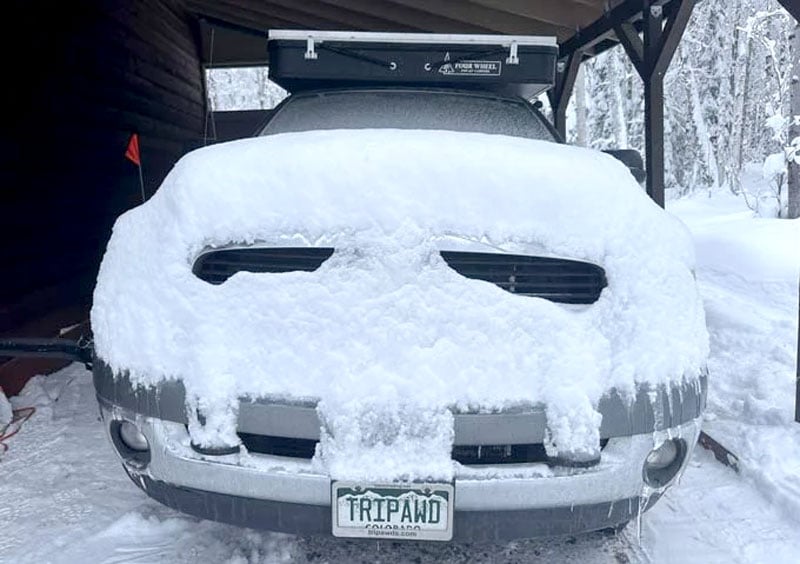
DAVE: I have a good one for you. So we have some friends. We almost can’t every New Year’s with them just to get out and catch up with each other. And luckily in Western Washington stays fairly moderate year round. But we do get some cold snaps and we happen to have a cold snap. It was in the low 30s, expected to get above 32 the whole time. We went down to a local state park down by Olympia and um, it was cold so luckily I was prepared. We took the park with hookups and water and and things to do in the area. We still, even though it’s cold, we get out and about. So while we’re there, I don’t carry a heat tape or a heated hose. So I went with water on board, figured we’d run it down. We’ll refill do that so I wouldn’t have to deal with frozen water hose. I do not have a four season RV technically, so my fresh water tanks in the belly, but it’s exposed, so I take a drop light and throw it up underneath there where the tank pickup is and tip right there. Use an incandescent bulb because you need good in cold weather and keeping that warm.
DAVE: So the pump. The pump could draw water, but eventually we did drop down, uh, in our water level. I try to keep a lot of water in it because we all know water is hard to give heat and cold too, so the bigger volume of water wants to take to freeze. So when it got down about a quarter tank or so, it’s time to top it off and get a fresh batch of water. And that can fight against the freezing weather. But the hose bib and the campground had froze because in Washington they don’t typically wrap too many because it doesn’t get cold for extended periods. So the three quarter inch line was exposed coming up the the back of the the post and it came through. So I got my wife’s hairdryer and an extension cord and went to work. I know it got that flowing again so we’d have water again. So we survived that and it got colder than we expected. It was getting down to the teens, which is quite cold in western Washington. So we had we had we always come out and sit around the campfire or go hiking or stuff. So our joke was you didn’t have to come in your RVs until at least 25 degrees in the morning.
DAVE: So we let it warm up. Brr. Um, and it was over a three day weekend, as I recall. And come Monday, we got there on a Friday, I recall it was it was freezing fog the whole time, so no sun, gray, cloudy, got some beautiful ice formations on on the RV, on the plants. The fog froze on everything. But we’re out there one morning. It’s like what you put in the fire. The ashes coming down really bad. That’s about the time we realized it was snow. When we left, it was supposed to be dry for days this foggy. Well, we hadn’t bothered to check an updated weather report to realize it’s snowing on us, and we get on our phones and realize it’s not going to stop anytime soon. So we broke camp, and my wife and I were just going to head for the hills. But our friends thought, well, we’ll dump while we’re here. They don’t have an easy spot to dump at home, and we weren’t five ten minutes away from where we left them to camp on a dump. They called. Our termination. Valves are frozen. We can’t dump.
JIM: No.
DAVE: So we didn’t. So, yeah, that was our cold weather story of we didn’t, you know, we went with enough clothes so we didn’t really freeze our butts off. He likes his campfire. We had big fire going, but maybe caught a little underprepared. Didn’t check the weather, didn’t think it was going to get to the teens and had enough equipment with us to get through it.
JIM: You know, you mentioned a few things there. That kind of leads me to think some things you just can’t avoid, like if the park isn’t prepared and that post isn’t wrapped, you know, that’s where the water starts. I mean, we’ve been arguing 18 years now, and before we left Colorado rookie maneuver on our part. We left the hose out overnight. We didn’t let any water drip. We didn’t have any heat tape. And sure enough, we woke up to a frozen hose. Yep, it happens to the best of us and sometimes you can’t avoid it.
DAVE: One other winter tip there is is we got caught a winter or two ago. We went to a park that we camped to in the summer quite often, but we didn’t think they shut their faucets off in the winter except for one faucet, which was the winter supply, so I didn’t fill up the trailer tank. Oh, we’ll get water when we get there. Well, it got pulled in, jacks down, got leveled up, went to hook the water up. It’s like, well, this doesn’t work. I checked the next site over, had to go find the winter supply, raise the jacks, hook back up. So lesson learned is make sure that’s been there.
RENE: We have been there. Yes. That happened to us in Wyoming. It was springtime, beautiful day out. And we showed up at a county fairgrounds and all the water was off. And my gosh, it didn’t even occur to us.
RENE: That that would happen. We were there just a little bit early in the season, but we were able to get some at the main source.
JIM: Yeah, there was one source still open and we hitched back up and went. So lesson learned. Plan ahead folks, and definitely weather.
RENE: Yeah, yeah.
DAVE: The weather. Make sure there’s water available.
RENE: Well, you know, some of the, the biggest cold weather situations that we have have been when we were out boondocking and we have made our share of blunders. But I’m sure you’ve had some doozies or, you know, of people who have had some doozies. And so I’m curious, what do you think is the number one thing that our viewers tend to forget to do when they want to go out, go to the desert in the middle of winter? Um, and how does that differ? Like when people mess up at a full service campground with hookups?
DAVE: Yeah. Number one thing is they don’t estimate how much power it’s going to take to run the furnace. Um, so they don’t have a battery capacity enough to generate because, you know, the RV furnace is power hungry and it can eat up your batteries really fast, your dry cap. So you need an alternative source of heat, like a catalytic safety heater or some other way to heat your rig, a diesel heater that pulls a little less of the 12 volt department because pretty soon your battery’s flat and you’re going to be running generator all day long, which that’s one of my pet peeves in boondocking. I don’t want to listen to it. I’m out there for the quiet, you know, is is staying warm, keeping that furnace going, and either having sufficient battery power or way to regenerate it. Because again, we’re in Washington state. You know, we get I think on the winter solstice we get six hours of sunshine, if you can see it, and the maximum sun angle 16 degrees. So solar is out. Solar is out here in the winter. It’s it’s not going to work for you. Lithium has been a big game changer. We switched almost two years ago now. And man those things are almost bulletproof when they’re supplying power because it’s not like your lead acid batteries. Well, they might be 100%.
DAVE: Maybe they’re sulfated a ways. You really don’t know how to reserve. You have the lithium, so you can really pound them. Last year we went winter camping. That was our first winter with them. I thought, well, I’m really going to test them. I left the heat up. I was running the lights. You know, if it’s a 2 or 3 day camp out weekend. You’d be hard pressed to deplete a couple lithium batteries on board. That’s. That’s one thing, being prepared that way. Uh, and newbies get this a lot. They’re nice and warm, but if their plumbing’s not in a warm place, like under cabinet stuff, they fail to open the cabinet doors or realize they should put heat in other parts of the coach, and all of a sudden their water’s not running. They’re wondering why. Uh, bingo. That’s our our current trailer. The pipes are on the floor right next to the heat duct. The floor ducts are nice, but, you know. Hey, if power’s available, I’m going to plug in that electric heater. Right. Well, one time it wasn’t that cold, but our water quit flowing. It’s like. That’s because I haven’t been running the furnace. It’s not getting that heat down in the sandwich floor. And it’s like, turn the furnace on for a while and wait.
RENE: Uh, so opening opening cabinet doors. That’ll help.
DAVE: Yes. Newer RVs with slide outs. A lot of times now, the plumbing’s been routed completely under the rig. But if you don’t have a slide out, some of the plumbing is still under the cabinets and runs full length under the cabinets, not just where it comes up to a sink. So if you can open this crack cabinet doors and let that heat circulate back under, like in the bathroom, under the kitchen, that will in really cold weather, that cold air will seep in and start to freeze those pipes by leaving the cabinet doors open and that air circulating. It’s a big help.
JIM: So it sounds like it’s.
DAVE: Really in here.
JIM: Yeah, it sounds like it’s really important to know your rig, know where the plumbing is, know the battery capacity and what you talked about the boondocking. I could see how that could be easily overlooked for folks, because an air conditioner requires AC power in most rigs. Yeah, and the furnace doesn’t. If you just have your DC power, you can still run it. So you might easily confuse things, and you might not know how many battery amp hours you have in your battery. Regarding those lithiums, how do they do in cold weather? I know lead acid batteries can freeze.
DAVE: Yeah the discharge. I wrote an article about that years back for you guys, but a discharge lead acid battery can freeze solid and it’ll blow it up completely. Waste the battery. Lithium’s one. One thing that’s kind of a I won’t say a misnomer, a myth. People say, well, you can’t use them in freezing weather or you can discharge them all day in freezing weather. It’s putting the amps back in that can damage them. So you either get one with heaters on board. Nice thing about lithium is you can build it. They don’t off gas what they’re charging. They can be in the interior of the RV, under a couch or somewhere where they’re staying nice and warm if you happen to be a winter camper. So that’s another big advantage of it. But otherwise you have to get really cold. I mentioned last year we went camping on New Year’s. I didn’t purposely did not try to charge them because it was a little bit below freezing and mine do not have heaters in them. But again, I was we were three days camping. I ran them hard. They didn’t need to be recharged so I didn’t even start the generator.
RENE: That sounds lovely. We still have lead acid in ours, don’t we?
JIM: In the trailer, yes, but in our camper we have a lithium and it’s got a heater in it, so it’s it’s pretty good there. And you can pretty much all the way. Yeah.
RENE: Yeah, definitely. Now, when it comes to boondocking, is there a good way to know if we picked a good campsite, like someplace that won’t, like, get I don’t know, that won’t expose us to the worst weather if it hits us.
DAVE: So several things. Again, we’re in western Washington. We’re moderated by the ocean in the Puget Sound. So our go to place is near large bodies of salt water that help moderate the temperature because they’re unlikely to freeze. And they’ll soak up a lot of that cold air if it’s going to be windy. You said you want shelter. Decide where the prevailing winds are so you can get in behind something. And third, like if you’re in the desert where you can get some benefit out of solar, you’re going to want to be exposed to both solar to charge your batteries back up and to heat the side of the rig. I mean, it’s heat coming outside of the rig, especially. A lot of these rigs are not coming out, are black sided, which I’m really against. But if you’re a winter camper, a black sided RV, I bet you heats up pretty good.
RENE: Makes sense. Makes sense.
JIM: You know, we talked about RV systems and things that can freeze and batteries and such, but what are the systems that kind of what goes wrong the most? I mean, obviously water freezes and batteries can be a problem, but what can we do? Say the night before or cold snap or what’s important to check because we talked about heat around the heat, tape around a hose. But that hose connects. And then there’s the filter. In most people. So what are the most common systems that are that we need to pay attention to when it’s cold?
DAVE: Plumbing is obviously number one, as you mentioned below. Freezing. Whether it’s not plumbing, friend or water is going to start to freeze on the whole situation. I’m a big advocate. I don’t use it. Don’t leave your hose out. As you mentioned, if it’s heated, I’m always we dry camp a lot, so we’re used to drying off our water tank. Then if your hose isn’t out there to freeze, you have to worry about if it’s a heated tape or something. What happens? The power goes out. Somebody comes by, bumps your plug, you’re frozen in the morning, and then you’ve got, you know, got a 25 foot frozen snake. What do you do with that? Uh. Been there, um, been there. So, um, that’s the main thing. The water heater. You know, if you tend to leave it off at night, you’re going to want to leave it on either tank or tank. Water heater that the tankless. They’re making advances, but the early tankless water heaters did not have freeze protection on board, so the newer ones read your owner’s manual. Most of them will come on about 38 and run for five minutes, then shut off again. But you gotta remember, on a tankless water, you don’t have a lot of water in there. Now a small amount of water will freeze quickly. We’re on a 6 or 10 gallon tank water heater takes a long time for that water to cool and get frozen. So know the limitations to your water heater, especially tankless. Read your owner’s manual. See what the limitations are on that.
DAVE: Um, again, as we covered extra heat, especially if you’re hooked up electric heaters. I’m a big fan of drop lights, where things are susceptible to freezing by bagging stores or something was not insulated. Insulation. Some people will put small, especially if you’ve got a basement model RV. They’ll put small electric heaters in there. Some people will get these remote thermometers, like you can watch your pets with Bluetooth it to their phone. They’ll sit there and watch what the temperatures are doing in their belly. If there’s plumbing down there to know if they’re close to freezing or not. Um. That’s smart. Again, know your rig. Learn how those cold spots are. One thing people think a lot is the gas electric refrigerator. If you’re equipped with a gas leak, they will get cold enough to start gelling up and quit working. Western Washington don’t see it very often. I’ve never directly experienced it, but our friend bought a newer rig with a NorCal fridge that had the winter package in it, which actually had a heating element that would come on to keep cooling it warm so it would start to gel. Now, on that subject, if you’re boondocking, obviously have an electric heater run the back of your refrigerator is problematic. So one thing you can do there is block up part of the venting. So not much cold air can rush in if you are hooked up. Again, I’m a big fan of sticking a droplight back there. Add a little more heat to the back, keep that circulation going and keep the cooling it from gelling.
DAVE: It’s 12 volt compressor fridge shouldn’t be a problem. Absorption refrigerant that can start to be finicky in cold weather, so know that. The other thing is, as I mentioned when I my personal experience is the holding tanks could freeze up. Back in the old time, old timers would just throw some rocks out down the toilet. It could be corrosive. So I really tell people the old timers had figured a lot of this out, but it’s somewhat outdated. Is RV antifreeze down the gray tank and the black tank? It will keep it from freezing. It will. It will still start to crystallize. A lot of people misunderstand antifreeze. It will freeze, but it doesn’t expand. So adding RV antifreeze will keep that slushy. So when you get to the dump station, you can dump it. If you’re an RV park where you’re you’re hooked up, then pull it and dump the tank. So now if you’re a newer RV or if you’re a cold weather camper, you can put tank heaters on to avoid that. And they make 12 volt heaters. So again, if you’re boondocking, you got to have a big battery pack to run those tankless or tank heaters. Uh, again, that’s a great spot to use RV antifreeze instead of your precious power to heat the tanks. There’s ways to do it, you know, you need to know what the limitations are, what how your rig responds to those things, and act accordingly.
JIM: So some of those ways, some of those ways might be myths. So maybe you can help clear something up with me. One thing that people tend to do or or wanted their husbands to do is drip the water. So at least they hooked up. But the water drips and I figure if you got your tanks open, you could end up with a frozen sewer hose in the morning. Or if you’re on, don’t have that open, you’re going to fill up your tank. So what about dripping the hose at night when it’s cold?
DAVE: Drip dripping the faucet is not a myth. People do it in their homes. Still to this day, moving water is unlikely to freeze unless it’s super, super cold. You might get icicles starting to form, so moving water now you could cover. The other part of that equation is if you leave the valve open, which you shouldn’t, you know, if you’re dripping water faster, you think your gray tank fills up night you’re sleeping. You know where the gray water comes out and the valves close. It comes up through your toilet or excuse me, up comes the shower first. And and if that plugs up or your stoppers, then it comes up out of your sinks. So that’s a bad thing to have happen if you leave the valve open. Now make sure your sewer line is maybe has a slinky that again, the water is constantly flowing. If you have a low spot that’s forming a p-trap, that’s that was called up, that would freeze. And then same thing. You’ve now plugged the system. That water is backing up, and you’re going to have a surprise in the morning that it’s it’s true. Running water will not freeze again. I would advocate this turn the city water off, pull your hose and drop your tank. The other thing is, if you’re you’re always drawing from your tank, if there is a problem, you hear your pump running. Hey, I blew a line under my rig. You hear your pump running, you’re going to know what happened. If you’re hooked to city water, you have no clue to your neighbor knocks on your door. You got water pouring out of your rig. So I’m a big fan of if anything’s questionable, use the pump. It’s a it’s a warning bell. If there’s not a faucet open, it’s running. Something’s going on that you want to be aware.
RENE: I never thought of it like that. Dave. That’s really helpful. That is super helpful. You know, we left Colorado in November for the winter season and it was getting really cold. We didn’t get snow, but it was getting down into the high teens at night. And I noticed that neighbors who were staying in the park long term were getting ready for winter by putting skirting around now. One neighbor, did you know the hole all the way around covered the entire side and back of the RV with good insulation, foam board, all that stuff. The other neighbor took big chunks of insulation blocks. It looked like.
JIM: 12 inch thick foam.
RENE: Yeah, and then just shoved him under her RV.
JIM: Just stacked it up all under the RV and without skirting.
RENE: Yeah, without skirting. And we didn’t get a chance to ask her. What? What are you doing there? So I’m wondering, does skirting help, and if so, like what? What do you recommend.
DAVE: The the main goal of security is to keep the wind from sweeping out the heat that’s leached out through the bottom of your RV. Number one, roll the foam board that could keep the the wind out and provide some insulation. The foam block. If it wasn’t taped together, then that air is still going to circulate out of there. Probably ineffective, maybe moderately effective. You want to stop the air movements. Your first goal at at insulation again that second. And it’s super you know, these guys that work in North Dakota and the oil fields, they’ll they’ll block them up, you know, put the foam bar and then they’ll put heat under there as well.
RENE: Maybe she did that right.
DAVE: Heat that space. So there’s one less spot. They’re losing heat, especially if they’re you know, they’re not paying for their power. Just push some heat under there.
RENE: This park charged for power. Yeah.
DAVE: But that becomes that’s when you start questioning okay.
RENE: I saw another neighbor wrap their large propane tanks with reflectix.
DAVE: Yeah.
RENE: Does that do anything?
DAVE: There’s some myth, some truth or some myth going on there. You know, if it’s you’re truly getting propane and butane, you know, butane will vaporize at 32 degrees. I chance you bought gas in Mexico somewhere way down south. There’s a chance you had a butane mix. You got propane. It’s going to vaporize. I don’t have the number in front of me, but it’s it’s in the the negative numbers.
JIM: Yeah.
RENE: It’s now.
DAVE: Right. So probably but when you’re, when the propane gets really low a little less pressure there, a little cold air added. It may not. Especially if you’re running your water heater a couple furnaces. It may not be able to vaporize enough gas fast enough to do what he wants it to do.
RENE: Okay. Fair enough.
DAVE: Reflex is probably wouldn’t do it. But yeah, there’s there’s some truth to what he’s doing. But if you just keep your tank full. Not an issue.
RENE: Well, that’s good to know.
DAVE: Volume there. Full pressure.
RENE: You had mentioned, uh, space heaters before. Do you have a preference for what you like?
DAVE: I like the oil filled heaters because we used to have a pet with us. Well, because you could touch them and it won’t burn you. So if you drop betting against it or paper towel on it, it’s not going to combust it. So it’s safe. It’s safe around kids. We have a large house and I converted the basement years ago. When they have slumber parties, when they’re like seven and eight, you don’t want kids sleeping bags in a, you know, a forced air or an open grate. Heater. Oil or oil filled heater is safe. It’s a soft heat. There’s no fan. So it’s radiated out. And again, I don’t I will never run on the full 1500 watt elements because RV wiring is just not dependable. I’ll run on the 600 to 900, but I’ll never run it wide open. But it’s a soft heat minimizes the fire danger much more than than something is blowing air. Something stops that up. Now most of the limit switches will kick out on a forced air, but you know you have the old open grill ones where you see the red glow right there. Those are definitely a fire hazard if something falls onto them. Again, when we had the dog, he’d want to camp near it if it was cold. So the oil field, he could lay right up against it almost. But if it were a forced air one, then that’s a problem.
JIM: So we don’t say the F word in RV. And, uh, my best tip when it gets cold is to head south.
DAVE: Yeah, I totally agree.
RENE: Well, Dave, that’s where we are this winter. And, uh, we hope that at some point you might make it down here because we could talk with you all day. You have so much knowledge.
DAVE: In one of these days. We’ll do it.
RENE: All right. Thank you.
JIM: Thanks so much, Dave.
DAVE: You’re welcome. Thanks for having me.
RENE: I love how many simple but smart tips we just heard. Like using your onboard tank instead of staying on city water when things get iffy.
JIM: And the reminder that you have to know your rig, where the plumbing runs, what heats what, and how fast your furnace eats up battery power. That’s the difference between a cozy winter trip and a long, cold night.
RENE: Oh, and I’m still thinking about the frozen snake hose problem. That alone is enough motivation to plan better, right?
JIM: Been there, done that. All right, we’re shifting gears a bit now, but staying practical.
RENE: Building something new on the road is a dream for a lot of our viewers. But behind the scenes of any business is always more complicated than it looks.
JIM: Rose and Glen are talking with RV entrepreneur Alex Haldemann about how he built the Ojai app, a digital take on greeting cards and what it takes to go from an idea to the App Store.
RENE: They get into tools, costs, learning curves, and how he worked on development while traveling full time.
JIM: Oh, hi. Here’s Rose and Glenn with Alex. See what I did there?
RENE: Aha.
ROSE: Hello, Alex. Welcome back to the podcast.
ALEX: Hi. Glad to be back.
ROSE: And I say welcome back because you and your wife, Jackie were with us on the lifestyle segment back at the end of December, talking about how you guys retired early and your RVing and boating full time journey, as well as your new venture, the Ojai App. And so today you’re back on talking about how to build an app, how you built it, and any tips and advice for the listeners wanting to give that a go as well. Let’s get into it. Briefly describe for us what your app does.
ALEX: So the Ojai app is meant to be a digital evolution of the greeting card. We really try to take the essence of the greeting card and the emotion of greeting card, and make it something very easy to send from your phone and really from anywhere.
GLYNN: I think it’s a brilliant application, but diving into the app, did you have any experience building apps before you started this?
ALEX: I had no app experience. I had done a little bit of web development and some of that translated over, but um, there was quite a bit of a learning curve in order to understand how to write the code for an app.
GLYNN: For sure. Well, I mean, when you’re talking HTML versus whatever code, was it done in Python or what code?
ALEX: The app is done in something called flutter, and we chose flutter because we wanted the app to be available for both iOS and Android, and that platform allows you to write one version of the software, and then it can be used for both iPhones and androids. And that was really important to us.
GLYNN: How much AI did you use and incorporate to write this?
ALEX: Good question. When I started the app, I tried AI and it wasn’t really. It made a lot of mistakes, so I didn’t use it very much at the beginning. And then at the end, I started using it mostly as like a sounding board or, uh, to help me understand, like, what are my options for, uh, if I wanted to accomplish a form. So I used it progressively more and more, and it’s gotten really good. Really good. Surprisingly good.
GLYNN: Yeah. In preparation for this podcast, I wanted to try myself because you see the ads everywhere. It’s like, oh, build an app. And Claude’s like, you know, there’s never been a a worse time to be a problem ad. So I decided for one of the, the companies I’m consulting for, I wanted to try using Google Gemini to build an app, and I was blown away at how how well it wrote. I mean, it made mistakes, it made a lot of mistakes. And then when you reenter it, it says, oh, my apologies, I made a mistake here. I’m sorry I missed that. And the functionality of the app is unbelievable. I don’t think it’s good enough to sell or to put on the market and generate revenue, but I’m blown away. So what you’ve done here with that is, you know, I really wanted to see what this was like.
ALEX: I had a similar experience at the beginning. It was very shocking how well it does. And it’ll get 80 or 90% there in what to me would take a really long time. So, uh, it’s I’m glad to hear you had a similar experience.
ROSE: So you chose flutter, but was there any other tools or any other platforms that you use to help you get going on this?
ALEX: No. Flutter really accomplished everything we needed it to do. Uh, there are some additional tools that we employed, like back end. We use a database back end because we wanted to be able to add new cards or, uh, really change whatever the content was in the app versus having everything statically in the app. And every time we’d want to add new cards, we’d have to do an app update. That just felt like it was going to be a little bit clunky. So really robust back end or database was important to us.
ROSE: Okay. And you did this all on your own or did you outsource anything?
ALEX: I did it all on my own, and I’m I’m kind of stubborn. Uh, just a little bit about me, but it helped me, um, learn, which is a really important thing for me. I wanted this process to be something I took from start to finish, just because I really was interested in learning how the process would work from, from beginning to end.
GLYNN: Well, that way you can never be duped going forward. You understand A to Z. Absolutely, yeah. So you mentioned the, uh, the database in the back end. Who’s hosting this for you?
ALEX: Uh, we’re using a platform called Supabase. It’s really, really good for app back end stuff. I’d recommend it. I’ve had a great experience using Supabase.
GLYNN: So spell that’s.
ALEX: P b a s.
GLYNN: Okay. Like super based, but super bass. Yeah, I got it. Okay. Yeah.
ALEX: One thing we found, which I’m guessing is why they did that, is getting a trademarkable name is getting harder and harder every day. So you come up with these strange word combinations. And my guess is that’s kind of how they landed there. But we had we had to do a little bit of that ourselves, trying to find a name that we could trademark for Ojai.
ROSE: Is there any little steps that you did that you feel might help a listener who wanted to do this?
ALEX: For me, the learning process was very much a start on YouTube. Watch a bunch of videos, do tutorials. That was my method, I think between that and AI. It’s amazing the resources that are available for someone who would want to learn something like this. So if it’s something you’re interested in, I. I can’t think of a better way or a better time to just dive in and start exploring because there is so much out there, if it’s of interest to you.
ROSE: Yeah. And you just went on and were like, how to build an app? Or were there certain things that you asked, you know, to bring up?
ALEX: Yeah. At the beginning, I started with what platform? What what language should I use? I started there, landed on flutter personally. I mean, that’s going to be I think that solution is going to be different for every app. Um, but that was where I started was let’s, let’s, let’s figure out what platform we’re going to use. And then it became, okay, now how do I learn flutter? I did a couple tutorials from start to finish, just to learn the app process and submitting to the App Store and getting approval. And there’s there’s a hundred different versions of, okay, now I have a new problem to solve in this process of zero to finished app, um, which I really enjoyed. If you’re a problem solver, it’s a it’s a really fun process. Frustrating at times. But um, yeah, you just learn to solve a bunch of really small problems on the way to one big problem of a finished app that you can actually download and install on the App Store.
GLYNN: How much do you think? You know, we start out, we all have this vision of an app. Yeah. And how many hurdles do you feel like you had to jump to actually get to that final version? And is it is it realistic to say that, oh, anybody can do this, or is it realistic to say that this is going to be a massive challenge and a lot of work.
ALEX: For our app? I would guess there were probably a thousand small problems, and a lot of times there was a cascading problem set where you’d you’d think you had one, one issue and then it would spiderweb into a bunch of other smaller issues like let’s say, um, authorizations and logins. Right? You say your app wants a email and password login. So you start with what you think will be the problems to identify that. And then you realize, okay, now I have to figure out how to make sure they actually type in an email address and not just, uh, a random string of characters. Yeah, I would, I would guess probably about a thousand small problems to get to where we are with a finished app. Uh, some of them are quick and easy to solve, and some of them were they felt like banging your head against the wall, trying to get to the answer on.
GLYNN: A lot of rabbit holes.
ALEX: Yes. Very much.
ROSE: Do you feel like this has all been worth it? I mean, if you want to do an app like putting all this time in and everything, is it worth it?
ALEX: Uh, for me, it was worth it because the process was part of the outcome that I was looking for. One of the things I’ll say is that I didn’t expect is with AI, it’s now easier than ever to launch an app, and there has been an absolute spike in apps. So you now have to compete with everybody else who’s using AI and pushing out their apps. That’s a challenge I didn’t quite foresee when we started this. Um, I would say it’s worth it for me because I’ve enjoyed the process. I think the gold rush of creating an app and pushing it out there and making $1 million is harder than it’s ever been.
GLYNN: It’s very diluted now, and I think you’re right. The gold rush is is at the point now where there’s there’s a thousand people right next to you with pickaxes looking for the same thing.
ALEX: Yeah, right. Yeah.
ROSE: If it’s a passion, if it’s a passion. Like I remember you saying this was a passion project and you enjoy the process and want to learn and and want to see it through. It’s definitely worth it.
ALEX: Um, I think so, yeah.
ROSE: And then quickly going back to your platforms, like the tools, can you give us an idea how much you’re spending? Like, maybe listeners would like to know about that as well.
ALEX: Sure, yeah. We’ve we’ve really tried to keep our expenses low as we try to build some revenue. So we’re we’re spending about $100 a month on server back end database expenses and software licenses. And that also includes an email marketing tool that we’re using as well. So we’re about $100 a month. There are a couple annual expenses that I’m not lumping in there, in there with that $100 a month, like you have to pay $100 a year to have your Apple developer license to be able to put something on the App Store. So there are annual expenses I’m not including in there, but that’s that’s how much we’re spending a month on back end and services.
ROSE: Okay. Yeah, that gives us a good picture.
GLYNN: It does. And that’s really fair.
ALEX: Which is not much. Right?
GLYNN: No, not at all.
ALEX: Yeah.
GLYNN: Did you have to build out the back end server with with my SQL and Python, or was that a ready made product?
ALEX: Supabase made it very easy. Um, I did have some experience with MySQL and those database, that database experience I had translated. And so it it probably accelerated the learning curve for me. But but something like Super Bass, which is a database as a service, uh, was surprisingly easy compared to my past MySQL experience.
GLYNN: Was there, um, one particular technical hurdle that was overwhelming and sort of trumped all others?
ALEX: One of the biggest challenges for us has been the bandwidth issues required to see all of the cards, because our cards are really small videos, and so everybody, when they’re looking at our app is looking at lots and lots of very small videos, and that’s pretty bandwidth intensive. So we’ve got to have a good solution to handle all the bandwidth, because everybody wants to see 10 or 15 cards before they choose the one they want. So we need to have a good bandwidth solution. That’s been probably one of our bigger challenges, was making sure if we have a spike in users, that bandwidth is available for people to look at all the cards they want to.
ROSE: I can imagine that that would be the biggest hurdle.
GLYNN: I would not have even thought of that.
ALEX: Yeah, I didn’t either.
ROSE: So you guys are full time on the road. So what did a development look like realistically while being like, could you just bang all this out?
ALEX: Question. Uh, for.
ALEX: Us, I was working on the app in, um, little bits and pieces, no matter where we were. So sometimes I was working inside our RV on the laptop. There were times anytime I could, I would work outside when the weather was nice. We have a we have a few pictures I snapped so that I could remember it, but, uh, like great views sitting in my camping chair working on my laptop. Those were great. Or there was one time we were in a field and some cows kind of wandered by while I was working on the app. Those memories are really fun to think about. It was a wide and varied, uh, array of working locations as we worked on Ojai.
GLYNN: Well, how many logistical challenges did you actually encounter? I’m talking internet space time.
ALEX: Yeah, we.
ALEX: Luckily we have Starlink, so internet was not a big issue for us. I think one of the biggest hurdles was when I first started the app. I was using a PC and I was actually using a different platform called React Native. That’s how I started. Um, and I learned that it wasn’t doing the things that we needed Ojai to do quite as well. It felt like I had to do a lot of workarounds to make it work. So we went back to the drawing board about six months into the app and started with flutter. And then I learned I needed a mac laptop in order to do a really good job of making the app for both iPhone and Android. So technically, that restart was a big hiccup that we didn’t foresee. Um, and it was it was a little frustrating to think like, oh, I’ve got to start all over again. But in the end, it was just another hiccup, a small challenge in the in the road to getting the app to the finish line.
ROSE: Yeah, part of the process. So did any parts of your travel kind of inspire anything with the app, or did it make it really harder to focus?
ALEX: Oh.
ALEX: Um, I wouldn’t say it made it harder. I think we have some really great ideas that we can hope to bring to the app that has been inspired by travel. We’d love to incorporate, um, some sort of national park connection because they’re just so meaningful to to us. As you guys know, as travelers, they just make such a mark on you that you’d love to think, how can I bring these wonderful places and feelings? And, um, are there ways to incorporate that into the park? Are there ways we can support the national parks through the app, or we’re looking for things like that that we’d love to incorporate some pictures. We have some wonderful memories, but but it’s also important we have to realize that the cards mean something to everybody else, not just us as travelers. So we have lots of ideas that we’re kicking around. Um, but, you know, travel has such an impact on you. I don’t know how it doesn’t influence the way you think about cards or the way people would use the app. So I don’t I don’t know that I could say that it hasn’t had any impact. There’s certainly influence it’s had on us.
ROSE: Definitely.
GLYNN: I am already visualizing the National Park Series greeting card.
ALEX: I would love we would love to do that. Or postcards, the hello from Yosemite or or you know. So those are all ideas we have kicking around. Um, but we’ve got 100 ideas we’d like to incorporate, so we’ve got it on the list. We’ll see when we can get to it.
GLYNN: What’s the like? The number one thing you learn building your first app on the road. Like the number one thing.
ALEX: The number one thing is it always takes longer than I thought it would. And I knew that, like, I think I knew it was going to take longer than I thought, but it took longer than longer than I thought, if that makes sense. Like, even when I added a little bit of buffer on, uh, it was just a little bit longer, things were there’s just the learning curve and, and challenges and um, yeah, that was, that was probably the hardest thing for me, was to stomach to just be patient and work through the process. And eventually we got there.
GLYNN: Hey, it’s good advice and be I. That’s what I thought you were going to say, right?
ROSE: All part of the process. Do you have any advice for the listeners? Anything else that maybe they want to build an app, especially while on the road? Any other tips or advice you didn’t mention?
ALEX: Sure.
ALEX: If this is something that interests you, I would say do it even if it’s not successful, by whatever definition you have. Um, the process was such a good learning curve, and from what I’ve learned from a lot of other developers, is the first idea you might have, or the first app you you try might not be the best one. So I think there’s a if it’s something you’re thinking about doing, just do it. It’s never been easier or more affordable to to dip your toe in the water because you might make something really useful or wonderful or that might make the world a little bit better. So I’d say go for it.
GLYNN: Go for it. Agreed? Yeah. Agreed. Because you’re going to learn by doing.
ALEX: Absolutely.
GLYNN: Alex, what’s next for Ogi? Other than the National Park Series greeting card?
ALEX: Uh, we’re always.
ALEX: Working to continue to add cards. That’s a huge lift for us. We we’re adding cards for all the the occasions we can think of and then the niches underneath the occasion. So we’re really trying to fill the app with cards that are for everyone and every occasion you might want. Uh, we’ve got a lot of feature ideas like we mentioned, the national parks. We’d love to partner with the national parks. Uh, we’d love to add a birthday reminder system in there so you could put your birthdays in, and and you’d be notified to. Hey, don’t forget to send a card to your cousin or whoever. You might not remember their birthday. Um, and then there’s a hundred other. Like I said, we’ve got a list, an active list of ideas that we would love to bring in, but those are the top, top three. I’ve been kicking around in my head.
ROSE: I like that.
ALEX: Me too.
ROSE: So as we wrap up here, Alex, where can the listeners find your app?
ALEX: Our app is available for Android and iPhone in the App Store if you search Ojai. Oh, and you can also go to Ojai. Com and there’s a there’s a link to download the app there.
ROSE: Excellent.
GLYNN: And for the listeners, it’s worth just checking it out to see, you know, now that you sort of know the back end and what it took to design this, it’s nice to see the finished product.
ALEX: Right.
ROSE: Excellent.
ALEX: Thanks.
ALEX: Thanks. We we really enjoy hearing from people and how they’re using it. So if you if you use the app or have a experience or an idea, we’d love to hear it. We really are just trying to make something that’s really useful for people. Um, and, and makes it easier to stay in touch.
ALEX: Excellent.
GLYNN: Beautiful. Alex, thank you very much for coming on the show today.
ROSE: Thank you.
ALEX: Alex, it’s my pleasure. I always enjoy talking to you guys. Thanks.
JIM: A thousand small problems. You know, that’s one of the most accurate descriptions of building anything from scratch that I’ve ever heard.
RENE: And it’s encouraging too. He’s not pretending it was easy, but he’s also not making it sound impossible.
JIM: Also, if you’re curious about the app, it’s Ojai. Oh, I check the show notes for details or find it in the app stores.
RENE: Up next, Bob takes us into what’s happening across the industry. And it’s a fun one because it’s all about getting new people to step inside an RV for the first time.
JIM: Go! Irving has been putting RVs in place where people least expect them festivals, fairs, tailgates. Big events.
RENE: And when someone walks into an RV for the first time and sees a kitchen, a bed and a bathroom, that moment is pretty powerful.
JIM: Bob’s talking with Monica Gerace from the RV about experiential marketing, big numbers, dealer involvement, and what’s coming with the RV. 250 A campaign for America’s 250th anniversary.
RENE: Here’s Bob with more fascinating RV industry news.
BOB: All right. Welcome back. My guest today is Monica Geraci, the PR industry spokesperson at Avia. And Monica, great to have you back. And, uh, you got a lot of things to talk about with respect to go RV.
MONICA: Yeah, thanks for having me, Bob. It’s always great to to chat with you. And yeah, I’d love to talk about some of what Gaurav has been doing, particularly in the experiential marketing area this year.
ALEX: Yeah.
BOB: And, uh, tell us what you know, because sometimes we have a new audience. I think a lot of new people coming into the RV, the new RV life podcast, talk about what the experiential events are and why they’re different than some of the other things that you’ve done in the RV industry.
MONICA: Absolutely. So experiential events is something that Gaurav has been doing for a number of years now. And basically the goal is to show have RV show up someplace where people woke up that day and they did not expect to see an RV. Um, so we put RVs at air shows, at food festivals, state fairs, um, country concerts, I guess concerts in general. Um, and then people come and they’re able to tour them. And the amount of people who say, oh my goodness, I didn’t know that there was a bathroom in here or a kitchen, um, or a bed. And we kind of think, well, what did you think were in these boxes rolling down the roads? But it’s it’s, um, really interesting and incredible. Uh, when you get someone who has never been in an RV to walk through one and just be blown away by what they offer. So experiential events have been a backbone for about a decade now for go RV. And this year, and this is the first time we’ve done tailgating things. But this year we partnered, um, with colleges and we went to five different college tailgates. We had a really cool, uh, wrapped gore being wrapped RV.
ALEX: Um, a lot of.
MONICA: Yeah, it was it’s really cool. It was look like turf on the side of it. Um, which one of the cool things about that is it was also driving from all the different locations. So there was a truck that was wrapped, too. It was wrapped orange. So even driving down the road, you just saw this cool go wrapped RV. Um, but yeah, we we did five different stops at college tailgates to again, just have people experience what an RV is. Uh, many who never had before.
BOB: Yeah. Now, on the experiential ones, because of the way you frame them and the audience that you were getting. Talk about the kinds of numbers. You know, because these numbers are substantial, especially when you look over, over the ten years you get you’re getting to events that are high profile events that have a lot of people.
MONICA: Yes. Um, there are So we threw all of our experiential events. We’ve had over 75,000 people tour the RV RVs, and then that doesn’t count the people who are just walking through the booth, or people who are just walking by the booth and seeing an RV for the first time. And because of the different events, it’s hundreds and hundreds of thousands of people just this year alone that were exposed to RV ING through this RVing experiential marketing program that otherwise wouldn’t have seen an RV. And a lot of these people not have seen the inside of an RV.
BOB: I think one of the things that’s surprising to our dealers about this is you partner with dealers in each of these locations, and they get an opportunity to bring a couple of units in if they don’t want to staff them. You’ve got staff there. Uh, but they get the leads and it’s it blows them away every time. You know, they always challenge us in terms of cooperating with something like that, because they look, it’s so far outside the mainstream. Some of them have to take a take a step back and say, we’re not we’re not going there to sell an RV. We don’t, you know, that’s that’s not the problem. Don’t don’t judge your participation by the number of sales you get. It’s the exposure to the people and new people that you can bring into the database. And the dealer on the local. He’s seeing all local people. They probably never been to his dealership.
MONICA: Yep, absolutely. Our dealer partners are so important to the success of the experiential marketing, because that is exactly what what we do. We partner with dealers in wherever the events are, are taking place, and they’re able to bring in, um, it’s usually two RVs. And yeah, they get those leads first. The people who sign up, um, we always have a giveaway of some sort. And so people sign up for the, the giveaway and that those dealers get back. Uh, those leads first. Uh, so, yeah, they are instrumental in the success of the experiential marketing.
BOB: How did it work on the Ultimate Tailgate Tour? Was it a similar process or. I mean, you’re going to college games to get 100,000 people, you know, for 3 or 4 hours, all in one spot? How do you how do you handle that?
MONICA: Yeah. So, um, it was a little bit different in that we didn’t for the tailgate, the ultimate tailgate. We didn’t partner with dealerships here because we had that wrapped RV. Um, so we did go ahead and and get an RV and wrap it. Um, but then, um, it went around and was in the tailgating events before all of these games. Um, and then we’re culminating at the, uh, Big Ten fan Fest that is happening. That happened in Indianapolis. Um, so that’s the the culmination of all of this, and at that we also had our nation, which is where all the RV tailgating happens. And we partnered with manufacturers for this final event, and manufacturers were able to bring in new units in that tailgating area where you already have RVers. So this is a little bit different. Usually we’re trying to reach non RVers, but in this case it was a good opportunity to add on um, and let manufacturers display new units in front of an audience or those people who are tailgating out of their cars in the same parking lot and come see these, these new RVs. So this one was a little bit different. So we had two locations, one in RV nation and then one inside the Big Ten Fan Fest, um, where there’s lots of games and giveaways and, and thousands and thousands of, I think so, over 75,000 people walking through and a lot of those coming into the booth to see the inside of this RV. We have a 360. Those really cool 360 video, um, booths. And so that people then get that sent to them with a cool go RV backdrop. Um, and then obviously we get their, uh, information, so we’re able to follow up with them and, and continue to tell them about the joys of RV lifestyle.
ALEX: Right.
BOB: Get get the data, get the data, get the data and get it into the database. Well, that’s that is marketing. Yeah. That is unique. It’s different because they’re you’re talking in a lot of cases to a, a pre-qualified prospect. They’re already doing tailgating whether it did in the car or they’re, you know, the back of their pickup truck or whatever. But there’s an awful lot of RV is similar to NASCAR. I mean, there are a lot of RVs that go to these major events. And, you know, I always encourage our dealers to get much more involved in that process, because you’re not going to see that many people in 3 or 4 hours, anywhere near light. Uh, we got a couple minutes left. Talk a little bit about the website, what they’ll find there and why it’s important to consumers.
MONICA: Yeah. So one of the really cool things that’s happening next year and that we’ve got some stuff on the website is, uh, America turns 250 next year. And, uh, there is literally no better way to see America celebrate America than in an RV. And so we’re doing something we’re calling it RV 250. So, you know, 250 also RV 250 states. Um, so RV 250 and we have a passport that is coming out in January and it’s going to be available for pickup at participating dealerships. Um, we’re going to send them out to dealers who who let us know they want to give them out. And for our viewers out there who are going to take some RV 250 trips. We are encouraging them. First of all, you have this password that you can put in pictures or draw things, little journal in it. But also if you send us giving us pictures or videos that you take on these trips that were then able to use to encourage more people to get out and go RVing. Um, we’re going to be giving out some swag to the first 250 people who submit their, uh, information. And then we’re also going to have a grand prize of, uh, having your camping fees paid for the year for, for one person, um, that will will select but on the website on RV 250, uh, RV 250, our, uh, travel guides. So why don’t you see there’s one um, for up in the Boston area going around the.
BOB: We distributed that to our dealers and to our consumers. Right. Yeah.
MONICA: Yeah. So there’s that. There’s one if you want to take if you want to take six months, you want to start in January. You want to take six months and and see the whole country. We got a six week one. We got a long weekend around the DC area. And then we’ve got we’re just going to continue to add to that. So we encourage people to either take some of these, be inspired by some of these trips, or take your own and share your experience with Go Irving. And maybe you’ll see some of those photos or videos in some of our, uh, social media campaigns and maybe get some swag or or your camping fees paid.
BOB: Well, you know, there’s no question that 2026 is going to be a great year for RVing. We’re going to we’re going to start coming back out of the, you know, the slowness that we’ve had the last couple of years. The market is good, the dealers have good inventory, but you’ve got the World Cup running all over the place. You’ve got America at 250 and you got the 100th anniversary of route 66. Take your pick, but hop in the RV and go.
ALEX: That’s the point. Absolutely.
BOB: All right. I guess today has been Monica, PR, industry spokesperson for BIA. We could talk for hours. Monica, but I’m sure you had a lot of other things on your schedule today. I appreciate it very much. Uh, stopping in and telling us what’s going on with RV.
MONICA: Always appreciate you having me on, Bob.
BOB: Thank you.
RENE: You know, there was a time when I would have scoffed at RVs in certain places, but I kind of liked the idea of RVs showing up where people aren’t expecting them. It’s introducing the lifestyle to new crowds.
JIM: And that RV 250 passport idea. It’s a cool nudge for people to plan trips and document them, especially with so much travel energy building in 2026. But enough already. That’s a wrap for RV Life podcast episode 152.
RENE: Today’s key lessons were about winter readiness from the road, chemicals you can’t see to the power and plumbing issues you definitely can.
JIM: Plus, a new way to stay connected on the road and what’s getting more people to go RVing. Big thanks to our guest, Ryan Hadley, Dave Helgeson, Alex Halderman, and Monica Drake. Connect and learn more on the episode page at podcast.com.
RENE: And as always, thanks to our whole host crew John, Bob, Rose, Glenn, and everybody behind the scenes who puts this show together.
JIM: That’s us. Oh, and you, if you’ve got some helpful tips or an interesting story to share. See how easy it is to connect with listeners at Podcast.com.
RENE: Until next time, stay safe, stay warm and remember.
DAVE: Plan ahead. Watch the weather. Make sure there’s water available.
RV LIFE: Rving is more than just a hobby. It’s a community. When you join RV life, you’re not just gaining access to a suite of tools, you’re becoming part of a vibrant community of fellow RV enthusiasts. Share your experiences, learn from others, and make your RV journey even more memorable. Visit rvlife.com to become a part of our community and start making connections that last a lifetime.
FAQs About RV LIFE Podcast Episode 152
Yes. Road salt and pretreatment chemicals can quietly corrode wiring, frames, leveling systems, and exposed components, which is why rinsing the undercarriage as soon as possible after winter driving is critical.
Underestimating power and heat needs, especially how quickly a furnace can drain batteries and how vulnerable plumbing becomes when heat is not circulating where pipes run.
It is realistic, but it takes patience, problem solving, and realistic expectations, as building anything on the road usually involves many small challenges rather than one big obstacle.
This Go RVing campaign is tied to America’s 250th anniversary and encourages people to explore the country by RV through curated trip ideas, travel guides, and a collectible RV 250 passport.
The RV LIFE Podcast is presented by RV LIFE – Tools that Make RVing Simple
https://rvlife.com