At a Glance: RV LIFE Podcast Episode
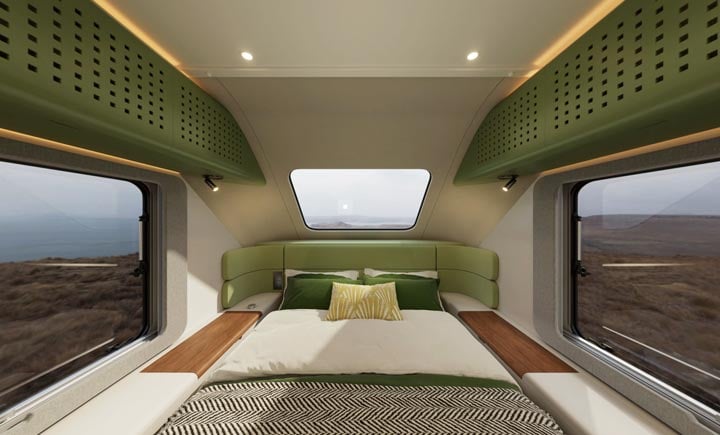
This episode of the RV LIFE Podcast takes you from the Mississippi River to the Pacific Northwest, with practical insights for planning memorable RV trips and getting more out of life on the road. You will also hear how Active RV Life is helping travelers stay physically capable of enjoying the lifestyle, plus a fascinating look at Evotrex and a new trailer concept built around electric power, onboard generation, and off-grid flexibility.
Discover the Great River Road, Pacific Northwest RV planning tips, fitness for life on the road, and Evotrex trailer innovation in RV LIFE Podcast Episode 157.
This episode is built for RVers who want better trips, better planning, and better life on the road. In RV LIFE Podcast Episode 157, you’ll get ideas for a scenic Great River Road adventure, practical advice for planning an RV trip through the Pacific Northwest, a smarter way to stay strong and mobile while traveling, and a look at a new trailer concept that could shape the future of off-grid camping.
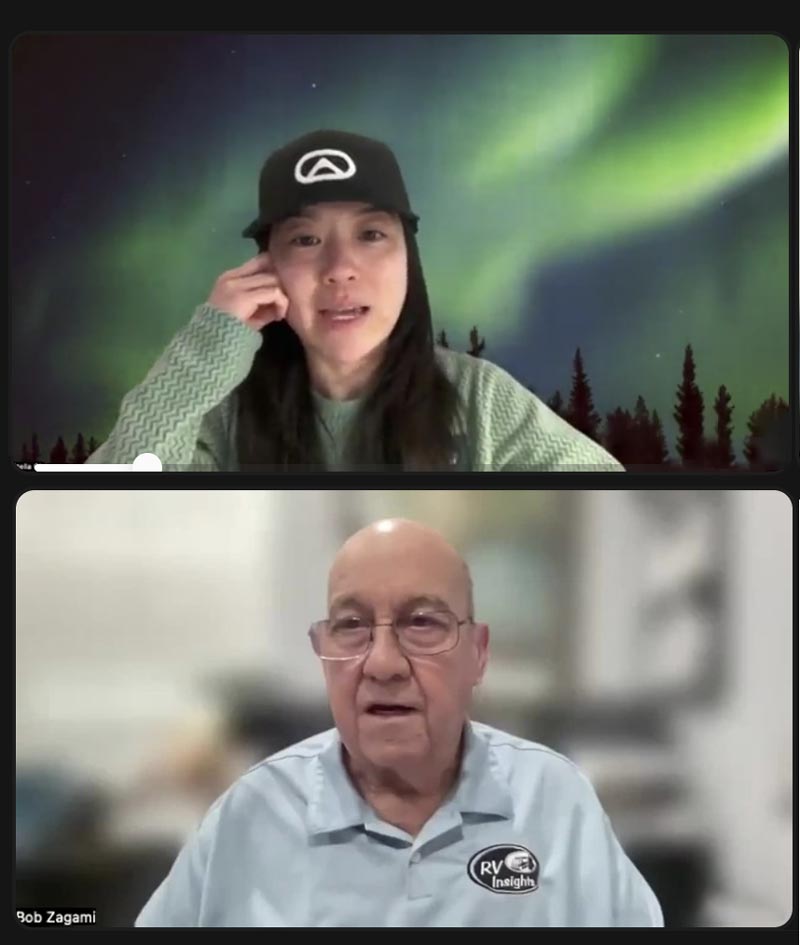
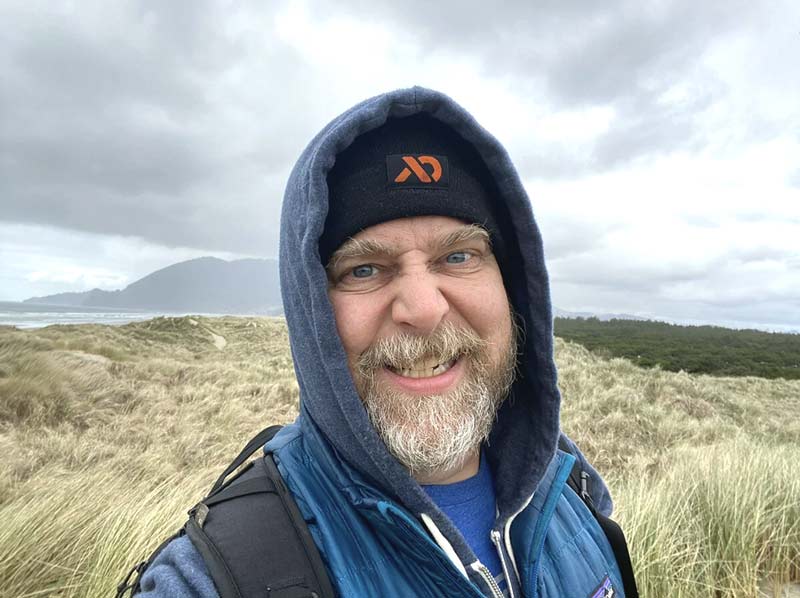
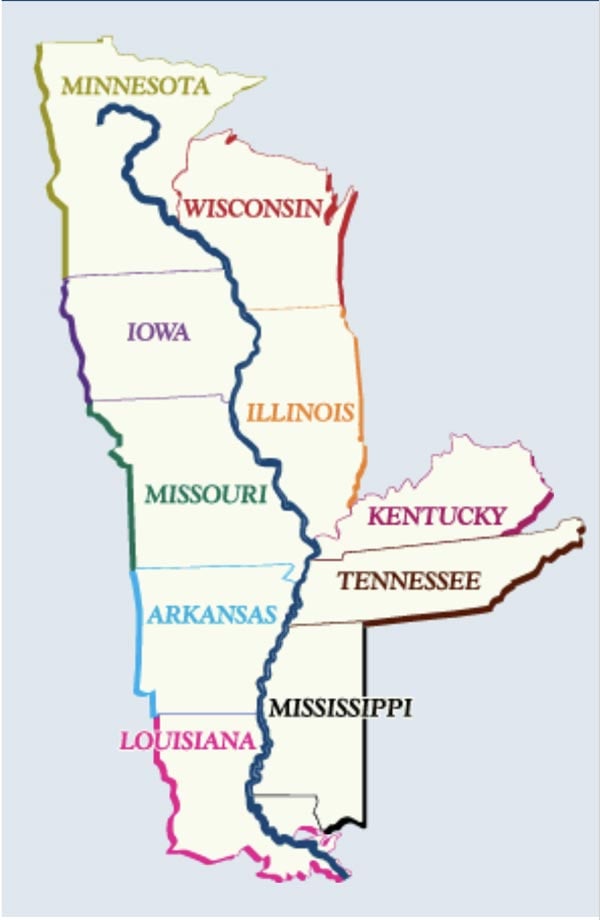
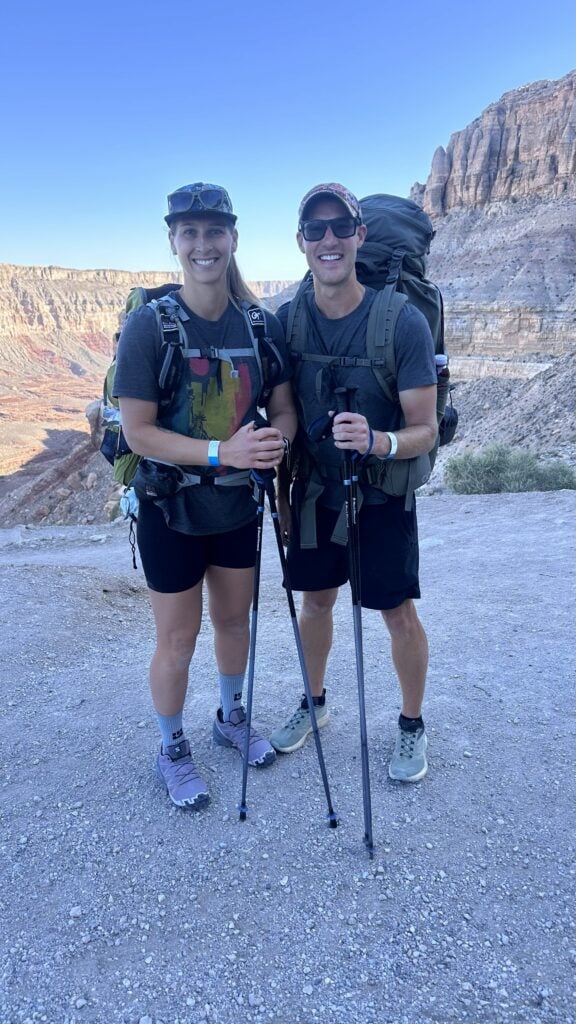
John talks with Alan Hamary about the Great River Road, a 3,000-mile route following the Mississippi River through 10 states, with river towns, local food, music, and flexible trip options for RVers who want to do the drive in sections or as one bigger journey. Jim and Rene sit down with Brooks Smothers of RV Out West to talk about what it really takes to plan a Pacific Northwest RV trip, from weather and mountain passes to slowing down enough to enjoy the region. Rose and Glynn speak with Jake and Sarah of Active RV Life about staying fit for the RV lifestyle, so you can keep up with hikes, sightseeing, and everyday rig tasks. Bob closes the episode with Stella Qin, co-founder of Evotrex, to explore the PG5 travel trailer concept and what it could mean for electric, off-grid RVing.
This episode is packed with travel ideas, practical planning tips, healthy lifestyle perspective, and a fresh look at RV innovation.
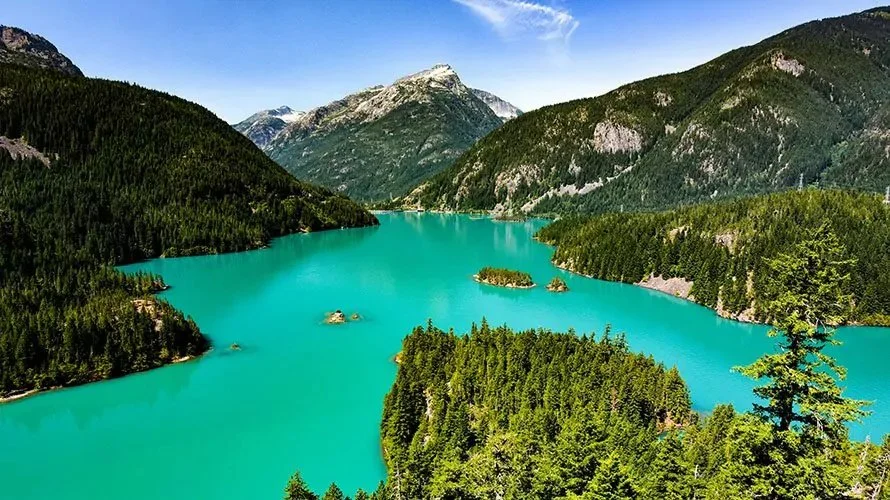
From the Great River Road to the Pacific Northwest, Fitness on the Road & Future RV Tech
Top Reasons to Listen Now
- Travel: Discover how the Great River Road gives RVers a flexible 10-state route packed with scenery, small towns, food, and history.
- Lifestyle: Learn why the Pacific Northwest rewards slower travel and what to know about reservations, weather, and mountain driving.
- The RV Entrepreneur: Hear how Active RV Life helps RVers stay mobile, strong, and ready to enjoy the lifestyle they worked for.
- Industry News: Get an early look at Evotrex and a new trailer concept built around electric camping, power generation, and off-grid capability.
RESOURCES MENTIONED
- Mississippi River Commission: experiencemississippiriver.com
- RV Out West: rvoutwest.com
- Active RV Life: activervlife.com
- Evotrex: evotrex.com
YOU MAY ALSO LIKE
- Brooks on The RV Entrepreneur #341:
https://therventrepreneur.com/small-business-marketing/ - Jake & Sarah Lifestyle Segment on RV LIFE Podcast #155:
https://podcast.rvlife.com/rvlife155/
Be A Guest or Share Your Story!
https://podcast.rvlife.com/contact
Listen to the RV LIFE Podcast Episode #157
Listen and subscribe to The RV LIFE Podcast on Spotify or in your favorite podcast app. Or, read the full episode transcript below. Leave a comment, or contact us with any questions or feedback.
Connect & Learn More
- https://podcast.rvlife.com/about
- https://facebook.com/rvlifepodcast/
- https://instagram.com/rvlifepodcast/
- https://www.facebook.com/groups/rvlifemovement
Got a great story or tips to share with listeners? Leave us a voice message!
(NOTE: Audio submitted may be published on the podcast unless specifically requested otherwise.)
Great River Road to the Northwest, Fitness & Future RV Tech – RV LIFE 157
FULL TRANSCRIPT:
“You’ve got your cheese curds in Wisconsin. You’ve got walleye in Minnesota. And then down south you got catfish.” – Alan Hamory
“Both Washington and Oregon state parks are absolutely crown jewels.” – Brooks Smothers
“You know, hey, like let’s just embrace this lifestyle cuz RV life is chaotic anyway.” – Jake Snyder
“It’s not meant to be rocket science.” – Stella Qin
JIM: Hello again. Everybody, welcome back to the RV Life podcast. I’m Jim.
RENE: And I’m Renee. Thanks for joining us again. We’ve got another fun and informative episode lined up with a little bit of everything. We’ll hear about another epic American road trip and some smart RV trip planning tips. Plus, we discuss fitness and wellness for life on the road and take a look at some very interesting innovation in the RV industry.
RENE: That’s right. John kicks things off with a travel segment that feels tailor-made for RVers. He’s talking with Alan Hamry about the Great River Road. This is the 3,000-mile route that follows the Mississippi River through 10 states from Minnesota all the way down to Louisiana.
JIM: And honestly, after all these years on the road, that is still one route on our bucket list. We just haven’t done it. There’s something about following the Mississippi through all those small towns, scenic overlooks, cultural stops, and changing landscapes. It sounds like so much fun, right?
RENE: We’ll get there. In our lifestyle segment, we welcome back Brooks Smothers from RV Out West. I’m excited to have Brooks back on the show since I talked with him all about marketing and branding on the RV Entrepreneur Podcast, episode number 341. That was a while ago, so we’ll make sure the link is in the show notes. This time, Brooks joins us to talk about all things Pacific Northwest, including why it remains one of the most overlooked and most rewarding RV destinations in the country.
JIM: Oh, and speaking of RV entrepreneurs, next up, Rose and Glynn sit down with Jake and Sarah of Active RV Life. Listeners may remember them from our lifestyle segment back in episode number 155 where they shared practical tips to stay active and healthy on the road. This time they’re talking about the business they’ve built around that mission, helping our viewers create healthier habits and stay strong enough to really enjoy the lifestyle.
RENE: And finally, Bob wraps up the episode with Stella Qin, co-founder of Evotrex, for a conversation about a special new breed of travel trailer that blends electric power, onboard generation, and some pretty futuristic thinking about where the RV design may be headed next.
JIM: All right, let’s get things rolling with a trip that covers 10 states and thousands of miles, all while following one of America’s most iconic rivers. Here’s John with Alan Hamry from the Great River Road.
JOHN: Thanks, Jim and Renee, and welcome to another segment of the RV Life podcast, a travel destination segment. And this segment is a little bit different because it’s not one destination, but it’s really 10 destinations all rolled into one. And we’re talking with Alan Hamry of the Great River Road in National Scenic Byway and All-American Road. And Alan, welcome to the RV Life podcast.
ALAN: Thank you so much for having me, John.
JOHN: You know, the first thing everybody wants to know is where is this Great River Road? What is the Great River? And that’s why we brought you on board today to tell us all about this exciting potential journey for our listeners.
ALAN: Yeah. Well, if you know where the Mississippi River is, that’s where the Great River Road is. So, it follows the Mississippi River from its start in far northern Minnesota all the way to southern Louisiana to the Gulf. So, it’s approximately 3,000 miles of routes that go through 10 states. As you mentioned, it is an All-American Road and a National Scenic Byway. So it offers a lot for people to see and do from outdoor adventures to culture to music to food to really anything you’re interested in, you can probably find some place to.
JOHN: And we should say, Alan, that this is not an interstate highway like 90 which goes all the way from Massachusetts out to the west coast, but a series of interconnected roads and I guess you kind of stay off the interstates, right? And in kind of small towns.
ALAN: Yeah, it’s mostly state and federal highways, US highways that go through the 10 states. You can kind of demarcate where you are by the pilots wheel signs. So you’ll see a sign that says a Great River Road in whatever state you’re in and it’s a looks like a pilot wheel that you used to steer an old timey river boat. And so that that’s kind of how you navigate your way through the route. And each state has its own section. The longest section I believe is in Illinois which is 500-something miles.
JOHN: Great.
ALAN: Yeah. And then there’s a real small section 60 miles or so in Kentucky. So, it kind of is a real that far edge, the far western edge. Yeah. So, yeah, it goes through, like I said, 10 states and all kinds of things to see and do along the route.
JOHN: Yeah. So, any RVer that has said, “My goal is to RV to all 50 states,” they can get 20% of their journey done.
ALAN: Exactly. Exactly.
JOHN: So, Alan, the part that I’ve read and I found very interesting here, it says 10 states and you know, plan on taking 10 to 14 days to it if you want to see things. But I’ve read that some people drive it. If you were to drive it from one end to the other, it would take you 36 straight hours of driving. I don’t know why anybody would want to do that, but I guess that’s just there for mathematical purposes, right?
ALAN: Yeah. We just kind of wanted to give people a picture of how long it would take to do that, but really you can take as short or as long a time as you want. You can do one state, two states, you can do all 10. There are people who do all 10. The people who do all generally break it up into maybe a year or two, northern section in the summer, maybe the southern section in the winter when it’s a little warmer down there.
JOHN: Oh, interesting. Okay, that’s true because you are running into two weather zones depending upon when you try to unless you do it all in July, right? You know, where when you get to the middle of the country, it can be rather hot. Do people—is there a preferred route north to south, south to north, or do you find people drive in and like go to St. Louis and then some go north, some go south? It’s not certainly not mandatory that you do the whole route, right?
ALAN: Yeah. It’s kind of based on what you want to see, where you want to go. We’ve done routes from north to south and south to north. It depends if you want to start New Orleans or start in northern Minnesota. You know, that’s kind of up to you where you want to go and like I said, what time of year. Obviously, the northern section is not as scenic in the winter, but in the spring, summer, fall, especially the northern part, the roads right along the river. You get those beautiful fall colors in the fall. That that’s a great time. In fact, September is what we’ve called Drive the Great River Road Month. So, that’s when we promote travel on the Great River Road. Yeah.
JOHN: And then say, “Okay, go to the northern states. You’re going to see some some great fall color along Mississippi River.” When you do that, then you’re beating the snow as you head south.
ALAN: Exactly. Exactly.
JOHN: Yeah. Again, you can do it one state, you can do three states, you can do 10 states. It’s really—how about the major cities that you might run into on this?
ALAN: Yeah. So, the bigger cities would be New Orleans, it’d be St. Louis, it’d be Memphis, and it would be the Twin Cities in Minnesota or the bigger cities. But along the way, there’s dotted with kind of small charming river towns in the north and south both. Galena is on the Great River Road. That’s in northwestern Illinois. That’s commonly voted as one of the most charming historic downtowns in the country. It’s got a lot of coverage. So, that’s where a lot of downtown buildings there are on the National Register of Historic Places. You got the Ulysses S. Grant home. That’s where Ulysses S. Grant was from.
JOHN: I mean, you could really do a cultural tour as well, you know, with the people up north are totally different foods and culture than than the Cajun down in Louisiana in New Orleans.
ALAN: Sure. Sure. Right. Do a culinary trip along the Great River.
JOHN: Yeah. There’s lots of lots of great foods.
ALAN: I know you’ve got your cheese curds in Wisconsin, you’ve got walleye in Minnesota. And then down south you got catfish. Got tamales. Arkansas has its own tamale trail that has a lot of old restaurants and old family restaurants and stuff on it. So that’s yeah, like I said, you can do kind of anything you’re interested and the vast difference between the north and the south is just kind of you get the whole spectrum of whether you’re doing culinary or culture or music—music tours are popular in the south.
ALAN: If you go through Mississippi, you go along the Blues Highway there, you go to Clarksdale, which is home to the Delta Blues Museum. There’s a Grammy museum in Mississippi on the Great River Road, so there’s lots—again, there’s lots, whatever you’re interested in.
JOHN: And you know, with this year that we’re in right now 2026, we’ve got the more than the bicentennial, America 250, and my guess is that small-town America is going to have tons of festivals and events and depending upon where you are—Fourth of July, don’t go to a big city, go to small-town America and really see the what the people did when they were living on the river.
ALAN: For sure. One thing I wanted to bring up in talking about those is in on the Missouri side of the Great River Road there’s the town of Hannibal, which is Mark Twain’s boyhood home.
JOHN: Yeah.
ALAN: So you can visit his home. There’s a museum there. It’s a really charming river town and every June, I believe it is. I think it’s in June. They have Tom Sawyer Days, which is a big community festival that’s got a parade. It’s got a carnival. It’s got activities and it’s got a lot of things tied into Mark Twain and the sources that he got for his Tom Sawyer stories. So, there’s a frog-jumping competition, there’s a fence-painting competition, I believe they pick a Tom and a Becky as
JOHN: Yeah.
ALAN: The king and queen of the event. So, there’s things like that. And then there’s also things like I mentioned Galena before, they’ve got a hot air balloon race every June. So, that goes above the bluffs and in northwestern Illinois there.
JOHN: You mentioned the Missouri side, etc. I didn’t realize that when the river goes north and south, you’ve got two sides of the river that you can travel on. And my guess is that there are enough places that you can cross the river to do the east side for a period of time, then do the west side for a period of time. And maybe you don’t want to do the whole route down, but you want to go down on the east and then flip over, come back on the west or whatever. But the thing I am very happy to see on the website—and we should say—what website do you want to send them to? Is it Experience Mississippi River or
ALAN: Go to experiencemississippi river.com, you’ll find a lot of the stuff that John has been talking about here. You can order a map. It’s not really a navigational map, more of an attractions map and just kind of gives you the lay of the land to plan your trip. But yeah, there’s a lot of helpful info there at experiencemissippi.com.
JOHN: Yeah. And one of the things that I know on that is where it has a little search bar. I typed in “campgrounds” and there’s a special page that will give you campgrounds all the way from Minnesota all the way down to Louisiana. With the bulk of our audience being RVers, that’s a major factor for them. But I’m sure there’s Harvest Host properties along the way as well and some local campgrounds that aren’t even included in that.
ALAN: Yeah, there’s a lot of great state parks and things. One to point out in particular if you want to see the headwaters—if you want to see where the Mississippi River starts—Itasca State Park in northern Minnesota is about a three-and-a-half-hour drive north of the Twin Cities. It’s beautiful. I’ve been there in the fall and it’s beautiful. And Lake Itasca is the headwaters of the Mississippi River. That’s where it starts. It’s 25 feet wide, but the Mississippi River starts. They have stepping stones in there and people like to walk across it in the summer. So,
JOHN: Yeah, that’s what I was going to say. There’s got to be a spot where you can walk across the Mississippi, and then when you get down to St. Louis, you can’t even see across the Mississippi, right?
ALAN: Yeah. It starts 25 feet wide and it ends up being a mile wide at some point.
JOHN: You see the barges. But it certainly looks like a great opportunity for RVers to do something different in this America 250 celebration. And we want to thank you, Alan Hamry, for representing the Great River Road. And let people know, Alan, give us that website one more time that you can find out more.
ALAN: Yeah, that’s experience Mississippi River.com.
JOHN: There you go. So, let’s get back to the rest of our show. This is the RV Life podcast. My name is John Deietro.
RENE: Thanks, John. As always, such a great conversation. And I have to say, the more I hear about the Great River Road, the more I want to go. It really sounds like one of those routes where the journey is the destination.
JIM: Exactly. It’s not just one stop. It’s a whole chain of experiences. River towns, food, music, history, scenic drives, and all the little places in between that you’d probably miss if you stayed on the interstate.
RENE: I loved hearing about how flexible it is, too. You can do the full route or just tackle a section at a time depending on the season, the weather, or how much time you’ve got.
JIM: All right. All right. All right. We’ll get there. Coming up next, we shift from one classic American route to one of the most beautiful and varied regions you can explore by RV, the Pacific Northwest.
RENE: We’re joined by Brooks Smothers of RV Out West, and he’s sharing why this region deserves a whole lot more attention from RV travelers. From the Columbia River Gorge to mountain towns, rainforests, and coastal drives, Brooks makes a strong case for slowing down and really exploring this corner of the country.
JIM: It was great chatting with Brooks again. Here’s our conversation with the host of RV Out West.
JIM: Brooks, thanks for joining us. It’s so great to chat again. You know, we last talked on the RV Entrepreneur Podcast, but for listeners who may not know RV Out West yet, tell us how the project started. What inspired you to focus specifically on RV travel in the Pacific Northwest?
BROOKS: Well, first off, Jim and Renee, thank you guys so much for having me on the show, and I’m excited to just talk about the Pacific Northwest. It’s a place that is very near and dear to my heart. So, I am a born and raised Washingtonian. I grew up here, lived through Mount St. Helens eruption. A whole conversation for another time. I was alive and I have vivid memories of when Mount St. Helens erupted.
BROOKS: You know, I’ve been to all 50 states as well and I moved away for a decade from my mid-20s and I came back. I just love this area. And so when my wife and I started getting into RVing, I’m a big podcast listener and listen to a bunch of podcasts. I was trying to find a podcast that would talk about places to go do RV travel and RVing in and around the Pacific Northwest. And there wasn’t really anything I could find—sure, I could find episodes from larger podcast shows like the RV Atlas or RV Miles talking about places to go and do things in the Pacific Northwest, but it was like a one-off episode.
RENE: Mhm.
BROOKS: There really wasn’t anything that would do a deep dive. And then COVID happened and it was a lockdown. We were doing a remodel to our sticks and bricks—not because it was COVID, it was just timing-wise. My daughter at the time was five and caused a flood in our house and so we had to remodel and then COVID happened. So I needed to find a creative outlet and so I was like, “You know what, I could totally talk about RVing in the Pacific Northwest.”
JIM: Yeah.
BROOKS: So it started with the “is this thing on” and next thing you know I’m like 180 episodes in and having a ball talking about various different places to go RVing and exploring and adventuring right here in the Pacific Northwest.
RENE: Fantastic. You know, it is one of our favorite places, too. We always seem to be bouncing around Oregon and Washington and Colorado. We can’t decide which one we like more.
JIM: So, I know that short list, too, when we were looking to move back. So, yeah, we we just love the region and there’s so much to see and do there and such different terrain from place to place. How do you decide which locations and destinations you want to share? Do you ever hold back? Is there a really special place where you’re like, “I don’t want this place to get overrun. I don’t want to tell everybody”? So, how do you decide what you’re going to talk about?
BROOKS: Okay, so first off, for my small group of camping friends that I camp with who hopefully should be listening to this episode, yes, there is one campground I do not talk about,
RENE: Which is where we go as a collective group and they have specifically given me instructions not to talk about that one campground. So, yes, there is one campground I don’t disclose on RV Out West for that reason.
JIM: Fair enough.
BROOKS: That said, I want to encourage people to come and visit the Northwest and RV here. And so, most of my audience is really Pacific Northwest listeners. They’re from Seattle, they’re from Portland, they’re from Bend, they’re listening from Boise. The big city areas are the big places in the Pacific Northwest. Now, that doesn’t mean I don’t have people listening who don’t live in the area who are looking to come here and trying to do their own research or find out other things and places to go and see. So, I talk about other destinations that I find that I like. You know, we’ve got Leavenworth in the Cascade Mountains, this faux Bavarian town that’s very iconic and in the mountains. But also Leavenworth is a great springboard place to go hiking or mountain biking or if you’re a winter camper. There’s skiing and great snowboarding an hour away, 45 minutes away. So, I talk about some of these places because I want others to experience—maybe you live in Idaho and when you come over, you only go to Eastern Washington or you go into Oregon to go to the Rogue River or to Bend or to some of these other places. And so I want to share places that are on the way. I did an episode where I just talked about the last part of the Lewis and Clark Trail that really only is affected by the Pacific Northwest.
JIM: Yeah.
BROOKS: And to think about where they started in Idaho and coming down off of that pass into the Columbia River Gorge and the majesty of the Columbia River. I can’t even imagine what that would have been like in that time frame that Lewis and Clark were traveling without an interstate and their wagon wheels and chuck wagons and all of those stuff. I think going, “Hey, I want to do an RV trip that follows along the route that they took.”
RENE: Yeah.
BROOKS: But yet, I now have my convenience of my ice machine, my memory foam mattress, and I don’t need to worry about the chuck wagon. I don’t want to drink cowboy coffee. So I but to kind of think about that and go, “Hey, that’s a really cool idea.” So that’s kind of where those lesser-known destinations I think are fun things to talk about.
JIM: I think it’s great that you’re sharing that kind of stuff. And you know, I’ve heard you describe the Northwest as an often overlooked RV destination. And we’ve spent a lot of time roaming around Oregon and Washington. I was surprised by when we discovered the Hoh Rainforest. A lot of people might not have cared for the weather at that time when we were there. But I know it’s hard to name like that one special destination and I know of one that you’re not going to mention. What’s one region or an area that you think completely surprises people when they first discover it by RV?
BROOKS: You know, it’s hard because I’m going to back up before I give you a straight answer.
JIM: Sure.
BROOKS: I think the thing that’s really interesting about the Pacific Northwest and even Washington State—if I were to make Seattle the epicenter—
RENE: Mhm.
BROOKS: Within a 4-hour driving radius in any one direction from Seattle: Let’s say you have the mighty Pacific Ocean. You have the temperate rainforest of the Olympic National Park—and there are only five temperate rainforests on our planet and only one in the United States and it’s right here in Washington State. You then have the high alpine area of the Cascade Mountain Range and so high alpine lakes and great hiking and skiing and all of the cool things about the mountains. And then in eastern Washington, you have the desert, the rolling wheat fields of the Palouse and wine country of the Palouse and the Columbia River Gorge. So, you have these crazy diverse ecosystems that are dramatic and mindblowing and vastly different.
JIM: Mhm.
BROOKS: In a three-hour drive, you can go through very different terrain. So, to think about a PNW place that would just be like, “What?”
RENE: Mhm.
BROOKS: I really go back to the Columbia River Gorge and from the mouth of Astoria up through Hood River. And then I go back to that idea what we were just talking about about Lewis and Clark and what that might have been for them the first time they dropped down into that gorge. I think the Columbia River Gorge—
BROOKS: My one comma would be Bend, Oregon.
JIM: Yeah,
BROOKS: Because Bend is that high alpine really cool area that if you’re any sort of outdoor person and you like hiking and paddling and kayaking and stand-up paddleboarding and mountain biking and trail running and the list goes on and on. Bend is like a playground for that kind of stuff. But I think for that first time, somebody who’s never been to the Pacific Northwest, the Columbia River Gorge, I guarantee you will blow your mind.
RENE: I would have to agree with that. I mean, we discovered it little by little and had no idea how different it could be from place to place. I mean, we’ve stayed—what was that place by the locks? We boondocked near the locks on the Columbia River. The Bonneville Dam.
BROOKS: Yes. Yes. Yes. Yes.
JIM: I believe that’s it. But
RENE: And they have the swim ladder for all the salmon to go up. Yeah. Yeah.
JIM: You know, I love that you’re an RVer and you give it that perspective because you can find a lot of shows about travel and destinations. John Day.
BROOKS: John Day.
RENE: John Day. Sorry. Yeah. John Day. Yes.
BROOKS: And the Painted Hills if anybody’s on my list. I didn’t even talk about that yet, but
JIM: Beautiful. Beautiful. You know, so being an RVer, you give it this perspective that other podcasts and travel series don’t. So I love that. But as an RVer, you know that the demand since COVID has gone way up and it takes some planning to plot out a good route and find places to stay. How has your style of planning a trip and the recommendations you give changed over the years from the time that you started?
RENE: You can’t just go out anymore and stop and stay there.
BROOKS: You can’t. And both Washington and Oregon state parks are absolutely crown jewels.
JIM: We are very lucky here with our state parks. They really
RENE: Definitely
BROOKS: Have full hookups. A lot of them will definitely have electric and water and then sewer dump on site in the campground. Maybe not in your campsite, but at least on property.
RENE: Mhm.
BROOKS: We have incredible state parks and they’re all on a rolling calendar—I can’t remember if it’s 6 months or 9 months. It’s a bit of a game. You wake up early and be like, “Okay, I need to have my morning coffee at 6:00 a.m. so I’m ready to rock at 7:00 to make a reservation.”
JIM: Right?
BROOKS: There’s a bit of that, but I think the overall—maybe my answer to that question is a little different on my approach to RV travel because what I’ve realized about RV travel now is that it’s really about my family time.
RENE: Mhm.
BROOKS: And when I think about the summers I have left with my children, that really narrows things down.
JIM: Mhm.
BROOKS: I have a 14-year-old, which means I’ve got four summers left. And then he’s launched. He’ll be going off to school or doing whatever he’s doing. He might still be here, but on the whole, I’ve got four summers left with him. And so, as a family, RV travel has really brought in for us the idea that we value experiences.
RENE: Mh.
BROOKS: And so, we choose to spend our discretionary income on having those experiences together as a family. And so the RV travel has really changed how we travel as a family.
JIM: That’s cool.
BROOKS: Which isn’t necessarily the answer to the question that you were looking for, but I think it’s a different way to approach what that looks like.
RENE: I think it really shows the value of the extra effort that it takes these days to plan a trip in a populated region like that just because it’s worth it. You see the value. You get to spend time as a family together. My best memories as a kid were RVing with my parents. I would not be a traveler today if it wasn’t for my dad taking us out every summer. So, yeah, these are lifetime memories.
JIM: What was that?
BROOKS: Did you ever thank him for that?
JIM: That is such a big question. I’m trying to remember. I think I did, right? I think so. He’s not around anymore. Dad, thank you. Hopefully, he’s listening.
BROOKS: I hope that happens for me. But I hope that what you said sheds light on the value of the RV lifestyle to experience and get out and explore those places. But for the other people out there with families or not, who are planning their trip and they think about the Northwest, a lot of them might get intimidated. It might be the Seattle traffic or mountain roads or the weather ranging from coastal rain to your Washington heat. What are some of the big misconceptions you might hear from RVers who might not have traveled to the region?
BROOKS: So, first off, let’s talk about the weather. Okay, right off the bat, let’s talk about the rain. You know, we very much like to joke and say we don’t tan, we rust.
JIM: That’s awesome.
BROOKS: And maybe that’s part to keep the California migration to stop coming to our doors. If there are any Californians listening, I’m sorry, but no. But also I think part of that too is that it kind of also goes back to what you had mentioned, Jim, earlier about the overlooked. And I think from the stories I’ve read online, the people I’ve talked to, that a lot of times we’re a pass-through state or a pass-through on your way to Alaska. We’re that last big springboard before you cross the border, head into Canada and start your route up Dawson Creek. Bellingham was the last stop for big major provisionings before you cross that border. And when people come up here, they don’t give themselves enough time to experience the area because they’re more focused on getting to their destination and their trip up the Alcan. And then it becomes a, “Wow, that place really blew my mind. I need to come back and I want to experience it more because it’s not what I thought.” It goes back to, hey, we have all of these crazy diverse ecosystems that are very different. Like I said, I’ve been to all 50 states and this place still blows my mind. And so I think that’s a big misconception that people don’t allow themselves enough time to stay. The other thing is—not to be getting political, and I don’t want to be—but I think current events and news sources are painting the Northwest in such a light that is not true, is not common, and they are finding those smaller voices who help push out that narrative of whatever it might be. And that is really not the case here.
RENE: I hear you.
BROOKS: Seattle is a great city. Portland is a great city. I feel safe in both of those cities. Does it have homelessness and tent encampments? Sure. It’s a city. You’re going to find that in any city you go to across the United States. I don’t think it’s more prevalent here than it is in any other city elsewhere. And that’s just part of cities, right?
JIM: And so I think there’s narratives coming out that are causing people to be like, “Oh, we don’t need to go there, or I don’t want to go there.” And ultimately, you’re cheating yourself.
RENE: Mhm.
JIM: Oh, I couldn’t agree more. I mean, that’s why I love your show because you take these deep dives into the region so that we can see that there’s so much to do in one little space of the country and it’s not what you think it’s going to be until you get there. Really our traveling style has always been keep your expectations low because everything is going to surprise you otherwise. If somebody is going to go to the Pacific Northwest and they’re not going to blow through there, what are some of the important things that they need to know to have the time of their life? Depending on the season, will summer be different from fall? What are some like your top tips for a newbie?
BROOKS: Sure. The biggest thing is no matter when you are here, layering is critical because our weather changes on a dime and I’m not just talking about the rain. I’m saying the temperature—in the summer it’ll be whatever it could be 80-90 degrees during the day but at night when you’re sitting around the campfire it drops down to 60 and you’re like, “Hm, I need to put a hoodie on or I need a sweatshirt and jeans now because it’s not shorts and flip-flops.”
RENE: Mhm.
BROOKS: That temperature swings and so you need to be able to peel off layers, put layers on, put a hoodie on, put a beanie on, take the beanie off, put a ball cap on. So, I think layering for those weather conditions. I think the other thing, too, is when you come in the summer, not knowing how far north we are and that the sun doesn’t set until 10:30 at night. It’s not quite Alaska. But, you know, as a kid, when it was like, “Hey, come home.” It was come home when the street lights turn on, not come home when it gets dark. Because if I come home when it gets dark, I’ll be walking in the door at like 10:45 at night being, “Hey, mom, what’s up?”
RENE: Um, and so, you know, I think that takes a little bit. You know, the sun comes up at 5:30 in the summer. It doesn’t set until 10:30, 11:00 at night. So, knowing that, and then the other big thing really is mountain passes and doing that travel.
JIM: Mhm.
BROOKS: You know, I have—my wife and I have—a Jayco 267 BHSW. So, we have the 26-foot bunk house with a slide-out. It’s about 7700 pounds. And when we first bought it, it was the first—actually it was the second thing I’d ever towed—but it was the first time it was something significantly larger than a pop-up to tow.
RENE: It’s pretty good size.
BROOKS: And I had an F-150 with the naturally aspirated V8 engine in it. And you know the sales guys were like, “Oh yeah, you can tow that. No problem.”
JIM: Famous last words.
BROOKS: No problem. And I could and I did. And I towed it over mountains and I used that truck and towed it over mountain passes and it was okay. But luckily I knew the roads. I had driven these roads numerous times, but there were times coming down where those truck brakes were hot and they were smoking and I’m coming down off a mountain pass to the point now that I have a one-ton diesel to tow a 7700-pound trailer
RENE: Because I’m in mountain passes and so using that exhaust brake and some of the power of that, you know, so it might be an overkill truck for the trailer I’m towing, but given the fact that I’m going over mountain passes, it seems like a good fit for me.
JIM: Oh, yeah. You can never have too much truck, I think. And I know you have a lot on the docket. Where’s the best way people can learn more about where you’re headed and what’s going on in the Pacific Northwest these days?
BROOKS: Sure. People can find us online at rvoutwest.com. I’m on Instagram, Facebook. I’m new to TikTok, so you can find me on TikTok. I’m learning that area right now. And obviously, you can find the show in any podcast app that you’re choosing to listen to RV Life in right now.
RENE: Well, we love your show. So, we are definitely going to get the word out about what you do because it’s really valuable and helpful. So, thank you so much, Brooks.
BROOKS: Yeah, you guys, thank you so much for having me on. I really appreciate it.
JIM: Ditto. Thanks a bunch.
RENE: You know, Brooks always makes me want to hitch up and head back to the Northwest. We’ve been up there so many times, but we still missed so much.
JIM: Oh, I know. And I really appreciate how he talks about the Pacific Northwest from the perspective of an actual RVer. It’s not just travel inspiration. It’s practical, realistic, and rooted in what it’s really like to camp and road trip through that region.
RENE: Right. And his point about not rushing through everything really hits home. There’s so much there from the coast to the mountains to the desert, river country. If you blow through it too fast, you miss the whole point, folks.
JIM: All right. Next up is another RV entrepreneur profile with a familiar pair. Jake and Sarah from Active RV Life are back.
RENE: That’s right. Our earlier conversation a while back now. They talked about fitness, mobility, injury recovery, and how to stay active enough to enjoy your RV lifestyle. Now, Rose and Glynn take the conversation in a little different direction and dive into how Jake and Sarah turned that passion into a business built specifically for RVers.
JIM: They talk about the health challenges they saw in the community, the platform they’ve created, and what it really looks like to build a business while living full-time on the road.
RENE: Here’s Rose and Glynn with RV Entrepreneurs Jake and Sarah.
ROSE: Hello, Jake and Sarah. Welcome to the RV Entrepreneur segment of the show. Thank you so much for joining us today.
SARAH: Thanks for the invite. We’re really, really excited about this.
GLYNN: We are really excited too because the health, fitness, and RV lifestyle come up constantly in our world. So, it’s really neat that we have some things in common. And you guys have been full-time RVers for 4 years now. And you’re the founders of Active RV Life, a fitness, nutrition, and wellness platform built specifically for life on the road. But before we dive into the business side, give us a quick picture of what active RV life is and the problem you saw in the community that made you say this needs to exist.
JAKE: So, it’s a place and it goes beyond just working out and getting a good sweat session. So, if you picture folks are preparing for either retirement or they’re preparing for travel, they have this idea of what travel is going to look like. And so, you’re picturing the open road and going to all these national parks and the hikes and doing all this sightseeing, what this great country has to offer. And leading up to that, your family has obligations, the work has obligations and before you know it, your health is starting to deteriorate and by the time that you get there, you don’t have the health to actually do the dream that you dreamed of doing. And so, we have a personal story where we had some family come down to St. Augustine, Florida to visit us. And it’s beautiful down there. There’s a lot of—it’s actually the oldest city in America. So, there’s a lot of rich history. There’s a fort, there’s a lighthouse, there’s all this stuff to do. And we go check the lighthouse out and Sarah and I go up and we’re heading up to the top and we kind of turn back and our family members weren’t able to climb the stairs of the lighthouse. And so, you’re there—like they were there. They saw the tours. They rode the trolley. We did all that kind of stuff, but you’re not experiencing how you envisioned. You’re not up on top the lighthouse looking out over the bay, over the ocean being there kind of seeing what the other folks are seeing. And so that’s what we want to make sure that we do is we really want to be huge advocates of health and fitness community getting people out there and really accomplishing the travel dreams that they’ve been working so hard for.
ROSE: You know what—the human body requires maintenance. And do you feel like when someone they initiate this new journey that there’s such a huge learning curve and it takes so much time to figure out how to back up the RV, where are you staying, that you disregard your personal health?
SARAH: Dude, you have no idea. People that don’t RV, they think it’s just buy the rig and figure it out from there. But yeah, you are right. There is so much behind the scenes that people don’t understand because you grow up in a home, apartment, things like that, and you slowly learn how to do these things. But in an RV, it’s just like, “Oh, let’s just try to figure it out as things are going” and driving it like you said, like trying to back the truck up on the hitch. There’s just so many little small things that people don’t understand. So I always tell people within the first year you’re going to be fighting a lot. Just understand it’s not you as a couple. It is RV life testing your limits and then from there how do you overcome those challenges with the RV and keeping your relationship afloat as well. So yeah there’s so many hidden things behind the scenes with just maintenance and then of course the health side of things as well.
GLYNN: Absolutely. So it really seems that serving this community just feels right, doesn’t it?
SARAH: Absolutely. Yes, it does.
ROSE: Yeah. So take us back to that beginning. You have this platform. So when you first started thinking about building a business, I guess you already knew that RVers kind of would be your niche from this story, but what made serving this community feel like the right fit?
JAKE: So, first like Sarah and I always wanted to start a business together. I was in corporate America. It was a great company. People were great. It was really a good experience, but health almost became secondary just because of the corporate lifestyle. So, long hours in front of a computer, sitting—it took a lot of mental strain from problems solving all the time. And Sarah had an applied sport psychology business and she’s working with athletes and other folks within the sports psychology realm. And so when we had an opportunity when I was able to quit corporate America, we wanted to do something that really aligned our personal life and professional life. And with being in the RV and the love of travel and the love of community, the love of health and fitness, it just seemed like here we go. It was kind of a dream come true. Definitely entrepreneurship has its struggles and so I’m sure we’re going to talk about that later. You have a feeling how hard it’s going to be, but until you actually do it, it’s hard to explain that to folks that haven’t jumped head first into entrepreneurship.
GLYNN: We had a business for 20 years and yes, it’s a tough task. So maybe you can walk us through what goes into designing a platform that you’ve tell us about your platform and then all the trials and tribulations of designing this platform that you have.
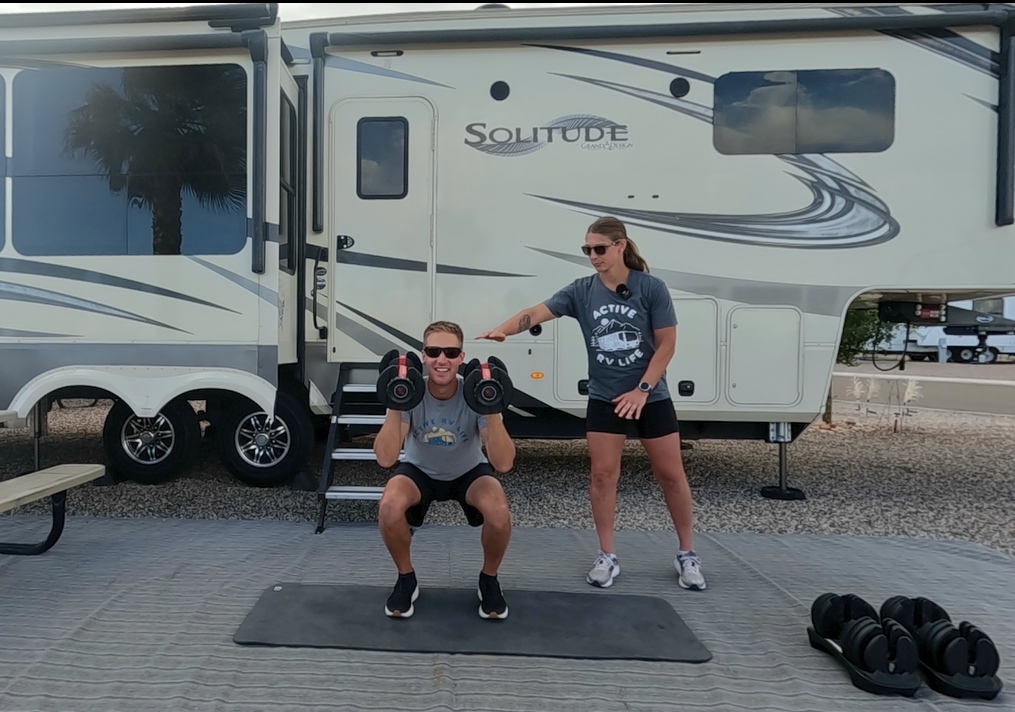
SARAH: Yeah. So with the platform itself like we understand RVing is challenging in itself—it is kind of a workout having to do all the maintenance and things. So when we’re building at it we’re basically trying to figure out the specific goals somebody is looking to do. Like I know Angel’s Landing is something that a lot of people want to be able to do, but how do you get yourself ready for something along those lines or even—and that’s like something really challenging like a hike that’s outside of your RV. But as we know, these RVs, they do use every nook and cranny possible for storage. Like our seats we’re sitting in, we can flip them over and there’s storage under them. But we also know, like I’m looking at our cabinets to the right of us, we have to stand on top of our couch to be able to get up there and we’re pretty young and that’s not too challenging but at the same time if we’re not paying attention about stepping down or how cushiony the couch is we have kind of fallen before or like we step down and hurt ourselves. So anyways with the program we really thought about more like the functional independent side of things especially for the 55 plus—we understand like we were talking about the cabinets up top so high reaches, but even those little compartments under your RV, you have to maneuver your body in such a way to be able to do that. And a lot of people are like, “Man, my body is hurting all the time.” We also know that if you have RV furniture, it’s just not great on your body. It’s just so much elements that start to build up to eventually it’s just like you feel tired all the time. So, anyways, our workouts are made to specifically help with that functional independence. Travel days. We understand travel days aren’t very easy. So, we created something that’s a quick 15-minute workout all body weight, but something that’s quick, fast that you can just do to warm up your body before tearing down your rig or even maybe when you’re done at whatever location you’re at, maybe just opening up your body again because we all know sitting is the new smoking. Like, we do it so much. Just opening up that body from there. So, we’re really thinking about all the elements of somebody that just wants to be more functional in their daily life, especially with how RV life is or things that just you want to have a nice consistent travel day, something that allows your body to wake up before having a long sit down travel day.
JAKE: Yeah, the community itself is evolving. Before the 55 plus demographic, you picture that Class A diesel pusher, that was the majority of what RVers were. And now it’s actually kind of migrating to kind of Sarah and I’s demographic where we’re in our mid-30s. and so we wanted to be able to like Sarah was talking about the workouts themselves, they’re tailored, they’re purpose-driven. So, if it’s for the 55 plus community, they’re designed in a way that it’s going to benefit them, benefit the fitness level and there’s things about like functional independence, mobility, flexibility and stuff, but also for that younger crowd that kind of like Sarah, what we were actually doing in the original reason why we started RVing was to follow the Spartan Race Series around.
SARAH: We needed something high-intensity to really help with her fitness. So, we do have programs that are more of that CrossFit style. We call it peak performance where I have a hard time doing the workouts myself.
JAKE: They’re challenging.
SARAH: And so it’s great and so you have the folks that want to do the 55 plus style with chair yoga, chair fitness, also the mobility and then you work your way down to like the active healthy lifestyle and we call it active lifestyle. So they’re approachable, they’re scalable, you can tune them up as aggressive as you want or scale them back down. So push-ups would be a great example. So, if you don’t want to do a traditional push-up, you could do it on your knees or even do it elevated on a picnic table or on the side of the RV. And then there’s the wild and crazy stuff with Peak Performance. So, we kind of have a good variety to fit
JAKE: A taste for everybody, basically. That’s what we’re trying to say.
ROSE: You do need a taste for everybody. And we watched that migration happen while we were out on the road, too, where it became younger and younger individuals.
GLYNN: So, you’re covering the grounds.
ROSE: Yeah. And your platform. So, this is follow along with you, kind of do the workout with you, or is this just you set up a program? How does this work?
SARAH: So, the bread and butter of it is the follow-along. Just coming up with workouts on the road in general can be challenging. So, we’re trying to make it as easy as possible. So, small spaces, limited equipment. Sarah has done an awesome job at keeping it fun and exciting. So, you’re not just doing air squats and push-ups. There’s some really cool body weight stuff and calisthenics that she throws in there. and then as the app’s growing—so it takes a long time to film and edit and do all that kind of stuff. So, we do have just like here’s what the standard workout is, here’s a demonstration on how to perform the movements, but the follow-along portion, there’s a little bit of a lag because it takes a long time to edit and do all that kind of stuff. So,
JAKE: And one last thing about it—and I know I’m rambling a little bit, but I’m passionate about it—that’s kind of set up like Duolingo where it’s kind of streak-based and so it’s really focusing on the consistency rather than perfection. And so you could show up and so you can have the support from the community members and it doesn’t matter if you’re doing the same program, you could still cheer each other on, kind of have that supportive environment that you would get from a brick-and-mortar gym. and you’re just meeting a bunch of people out on the road and building the community that way.
ROSE: Yeah. Speaking of community, I mean, it’s obvious that that is the core of what you’ve built. So, at what point did you realize this wasn’t just about workouts, but the connection and accountability?
SARAH: So, that’s kind of where we understood in the first place—when we first started RVing, we were basically racing a lot and we kind of forgot like we made a community in the races we were doing, but we kind of forgot to make community in the RV space. It’s like, man, we kind of screwed up a little bit. And we realized like one of the moments where we were just at an RV park, we ran into some people and they are super awesome. They just kind of invited us in their little hangout session rally that they were having and it just made so much more sense having community in person because as you know online it’s a little saturated until you actually meet that person in person. Like, who is this? There’s so many people doing so much random stuff and you want to be a part of that community, but it doesn’t feel like it sinks fully until you see them in person. So, we kind of started this because we care about the community and accountability and it also just makes it more fun. A lot of people look at fitness as something that’s unappealing because it can be strenuous and intense and tiring, but that’s not why we’re doing this. We’re trying to make it fun, exciting, and having a community a part of it. So, yeah, that was kind of the premise of us starting this in the first place.
GLYNN: That was smart.
ROSE: That was very smart and necessary. You’ve also gone to rallies and shown up in person. How much has that helped?
JAKE: It’s been a huge help. So, kind of like what Sarah was talking about—there’s so many influencers. There’s so much like fad diets and fad exercises and you don’t know if they’re credible. Or you know, what program do you do? and so starting out from that grassroots where we’re going to—so we have a Grand Design, so we go to a lot of the Grand Design rallies and meet those folks. Completely awesome. We’re so very fortunate we got some mentors. So just meeting with them and then building that credibility and then asking for feedback, you know, what works for you, what doesn’t. We’re able to have those face-to-face interactions. and I do want to give a couple shoutouts. Like Scott and Denise Thompson, Jarrett and Jen Burnett and the Hubbards, they’re some of the wagon masters for Grand Design, just taking us under their wing and just helped us out tremendously. And everyone’s—it’s just like a tight-knit community. So, it’s really cool that we were able to do that. And then now we’re kind of getting out online. And so, we’re meeting a lot of them down at Quartzsite here at the RV show in Arizona. So, it’s going to be so much fun. We’re going to have a lot of fun.
GLYNN: Yeah. I mean, you can’t do it alone. It takes a village being an entrepreneur sometimes.
JAKE: For sure. For sure.
ROSE: Your passion comes through. I mean, your excitement is definitely coming through. Getting back to that entrepreneurship. I think you said that you were in corporate before jumping into this. How was that transition for you? How do you like being an entrepreneur now?
JAKE: I prefer it. and so with corporate America, you have the board of directors, there’s a standard operating procedure. You have to stay in your lane a lot. and so there’s that structure that’s there. And some folks, they like that’s how you want to operate. I love the freedom. I like wearing multiple hats. I like getting my hands dirty. And so, helping Sarah design the workouts to going out to market to doing workouts with people on the road. it is not all Instagram.
SARAH: It’s a lot of hard work.
JAKE: And she likes not sleeping. Basically, that’s what he’s trying to say.
ROSE: Well, it sounds like you guys are a great team, so that helps.
JAKE: Yeah. And super super lucky. So, you know, with the business back-end and doing all the tax documents and all that kind of fun stuff, I can gravitate more towards that where Sarah’s like the fitness guru expert. She designs all these cool programs.
SARAH: Yeah, I like being hands-on. doing the work and he’s kind of behind the scenes creating all the backend type of stuff that I just don’t understand and that’s where our team dynamic, like you said, works really well.
JAKE: One thing that it took me a long time to kind of—I don’t want to say calm down but have a mindset shift. So like in corporate America you have a lot of resources, you have a whole team, there’s different departments you can rely on, you can delegate a lot, there’s a lot of KPIs and things and milestones that you’re following. And so like for me to realize, hey, it’s going to take twice as long, it’s going to cost twice as much, you’re wearing multiple hats, you just have to embrace the journey. and in the beginning I was kind of getting stuck—like we were going to launch at this date and we were supposed to have this. My coworker is my spouse. And so like that excitement was kind of—we’re just figuring it out as we go. And so it took me a long time to kind of reel in and, “Hey, like let’s just embrace this lifestyle because RV life is chaotic anyway.” and so it’s been fun.
ROSE: Jake, Jake, give yourself some grace. Okay, man. You got plenty of time. Is—do you feel like—is there one lesson that you learned the hard way when you were starting this?
JAKE: That is 100% it. So, I had these milestones in my mind and just trying to push and drive. And it was just like Sarah almost had to break me out of it. She’s like, “Listen, you know, you don’t have the corporate America team. We don’t have the resources. We’re doing this ourselves. We’re learning as we go. Let’s just take a break. Smile, relax, embrace this journey.” And so that the constant feeling of being behind and there’s always something to do. it’s just an imaginary finish line that you just have to embrace that. Just like with fitness, you have to embrace the process. Trust in the process and everything’s going to work out.
GLYNN: That’s great advice for
ROSE: Yeah.
GLYNN: For anyone trying to start a business on the road, period.
SARAH: Yeah.
ROSE: Go ahead, Sarah.
SARAH: Well, I was going to say besides that hardship that Jake was having, another thing was just like we were trying to make the conditions perfect for filming, too. And I’m like, “Are we like—”
ROSE: We know that one.
SARAH: Exactly.
GLYNN: I forgot about that one.
SARAH: And we all know that’s not how it works. Like we have an RV that’s right in front of us. Their dog barks every second of the hour. We have a street right next to us. there’s kids that are running around like crazy. Dirt bikes, side-by-sides. It’s just a mad house sometimes. And I was trying to be like, “You know what, RVing is messy.” Our videos, of course, we are going to try to give the best workout, but if something happens, we have to roll with it because that’s what RV life is about. So like just a quick story, we were trying to make the filming perfect. So, we purposely stayed at this RV park. It’s called Settler’s Point. They worked with us tremendously to help us with our filming, but we purposely stayed here for multiple months because we’re like, “The setup for filming is fantastic.” Now, if you know where Settler’s Point is, it is in southern Utah. And when April hits, it gets hot and then May is extremely hot. And then June is like, “Why are we here?” So, we realized that our camera was shutting off on us because it was getting too hot. It was overheating. Yeah. It’s just like, why didn’t we make these things black? Like, why do we need to make them lighter color so the sun doesn’t just beat on it?
ROSE: Put it in the freezer. I had
SARAH: We had—we had to put in the freezer once.
GLYNN: Yeah, I’ve definitely done that. Jake’s like, “What are you doing?” I’m like, “This is just how it works. You just got to throw it in there. Don’t ask.”
JAKE: And so then I had the bright idea of, “Okay, let’s get like a canopy.” So, it’s like a 10 by 10 canopy. I didn’t secure it well enough. Well, again, in the desert down in St. George, the high winds—and so that’s another thing we learned. And the canopy blows on the side of the RV, flies out.
SARAH: Thankfully, it didn’t hit any other RVs but ours. And it was just like, “Okay.” And then we realized, okay, because of the heat—and it would get up to like 108 during the day—if we didn’t film by 9:00 in the morning, we
JAKE: Covered 7:38 a.m. we have to cover everything with towels.
SARAH: Just—you can’t even lay on the exercise mat because you’re burning your skin. And so going back to that corporate mindset where everything was controlled and had to be perfect and you had to you know you’re presenting in front of the C-suite—and Sarah’s like, “We’re not going to get that here.”
ROSE: Yeah. So RV life is messy and that’s okay. People want to see the real life—you know it is what it is. But you guys, you sound like you’re doing a great thing with your platform. This has been a lot of fun chatting with you and kind of getting to know you and what you’re doing. but where can people listening find you today?
SARAH: So, we are on—I don’t think every social platform—but Facebook, Instagram, I finally got TikTok and YouTube. everything has the same handle, active rbby life dot, active rbby life. And then if you want to learn anything about our portal, you can go to our website, which is just activerblife.com. You can go check out every single program that we have and check out the portal from there.
GLYNN: Awesome.
ROSE: Beautiful. Thank you both for coming on today. This has been very insightful.
GLYNN: Yes, thank you guys.
SARAH: Yeah, thank you so much for having us. This was amazing and we really appreciate what you guys are doing as well.
JAKE: Thank you.
RENE: I really love what they’re building. It goes way beyond exercise. It’s really about helping people stay capable of doing the things they dreamed RV life would let them do in the first place.
JIM: Exactly. It’s one thing to plan the trip. It’s another thing to make sure you’re able to enjoy it and keep enjoying it.
RENE: You know, I think that message resonates with so many RVers, no matter what age or stage they’re in. You want the freedom of the lifestyle, but that freedom does come with some real physical demands.
JIM: All right, to wrap up this trip, Bob has an exciting industry conversation that looks ahead to what may be coming next in RV technology.
RENE: He’s talking with Stella Qin, co-founder of Evotrex, about their new travel trailer concept that combines electric capability, onboard power generation, and some very forward-thinking features for off-grid camping and towing.
JIM: This trailer is incredible, and this is a fascinating look at where innovation in the RV world may be heading, especially for RVers interested in new approaches to power, energy use, and trailer design.
RENE: Here’s Bob with Stella Qin.
BOB: Okay, today we’re with Stella Qin, one of the co-founders of Evotrex, right?
STELLA: Yes, Evotrex.
BOB: You know, I I always Evotrex. Yeah, I have a trouble with that in terms of whether it’s the K or the X on the end. But welcome Stella. And why don’t you start if you would with giving us a brief introduction of the company?
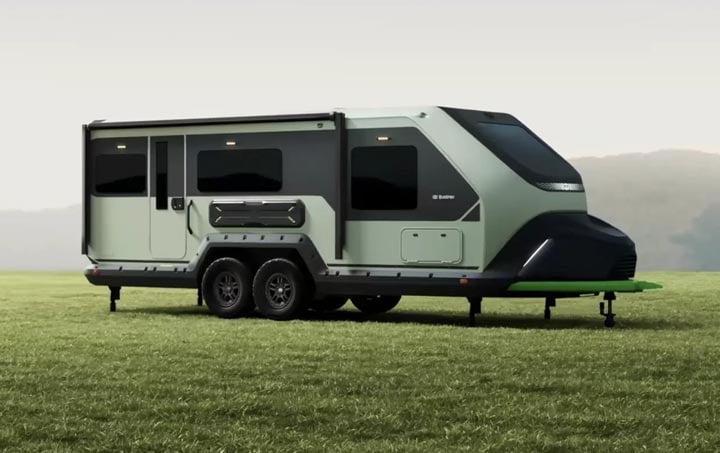
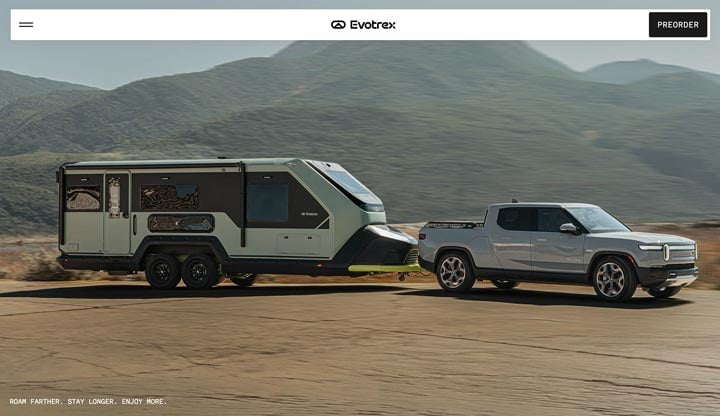
STELLA: Yeah, absolutely. And thank you for having me on Evotrex. We are a team that makes better travel trailers to enable a more free and unlimited camping experience. So the Evotrex PG5 is our first travel trailer that is not only electric, but it goes beyond on electric to be power generating, meaning that we have integrated a system called Horizon. It is an automotive engine slash generator that can have fuel gasoline input into the Horizon system and basically generate unlimited power for your use whether it’s on the road when you’re camping or even as you’re parked in front of your driveway to act as a power backup in case your house goes out of power.
BOB: Very interesting. How did you come up with that kind of technology? It’s not all electric, but you mentioned different power sources. Was it just genius? I find it very interesting and I’m not a technical person, so I should probably tell you that upfront.
STELLA: Yeah, of course. Of course. And it’s not meant to be rocket science. So, what drove us to come up with the idea is seeing the demand or some pain points as a firsthand camper. I myself as a van lifer and Alex our founder is a big-time camper and RVer as well. Seeing that need—and unmet need actually—for off-grid power and also having the knowledge and experience in the power technology and electric vehicle world. And we see that there is the technology that can solve that problem, which is bringing power-generating capacity or capability to the electric RV space. And how it works is that we have put in an automotive-grade engine or generator that is much more efficient and delivers much more power than a traditional RV generator. Bringing that on board together with a very large battery pack to provide you an experience you can electrify your travel trailer at camp, but also recharge it as long as you have access to gasoline.
BOB: Interesting. Now, how about the weight of the trailer with the generator, with the batteries? RVers are always interested in how much it weighs because of what they might be able to tow it with. So, what do you recommend that they tow the trailer with? And how about the weight issue?
STELLA: Yes. So, at this moment with the PG5, the dry weight of the trailer is about 8,500 pounds with everything loaded. the GVWR is rated at now 95,000. So, and that weight is definitely not categorized as a lightweight trailer, but you would be able to tow it. It’s totally doable with most of the half-ton pickup trucks, whether it’s gasoline power, diesel power, or electric pickup trucks like the Rivian R1T or the Cybertruck or Ford Lightning—all of those models can easily tow this trailer. I would like to add actually because there is power assist—we call it active power assist. The wheels are designed to be motorized and self-propelled.
BOB: So you don’t reduce the range of the vehicle.
STELLA: Exactly. You don’t reduce the range. You don’t impact on your mile per gallon.
BOB: Right.
STELLA: Right. It helps with that definitely. And it takes a lesser toll on whatever the towing vehicle is. So with that I think—and we know—that most of the pickup trucks that can comfortably tow this trailer.
BOB: Wow.
STELLA: Yeah.
BOB: Again very interesting and I think it would be very attractive to many RVers especially as we start to see more and more adoption of the EV technologies. Now you were saying right now from a marketing or sales standpoint you’re taking pre-orders.
STELLA: That’s right. That’s right. At now on evotrex.com, you can pre-order or put in your reservation for $100. So, that basically secures your spot. One of the earlier adopters or earlier owners of Evotrex. And as we approach closer to production, we will reach back out to everyone to configure their final trim model and finalize on the setup of their rigs.
BOB: Okay. Now, when do you anticipate production models coming off the line?
STELLA: Yes. Now, we’re planning for production to begin late 2026 or early 2027. Working very hard towards getting people on the road on the camping season of 2027.
BOB: Well, it’s a beautiful looking trailer.
STELLA: Thank you. Thank you.
BOB: Design is great. Now, is it too early to anticipate what the selling price would be on that?
STELLA: So, actually, we do have the MSRP listed on our website. the starting trim which is called the Pioneer model starts at 11,990 and then there is a premium trim Atlas. That price includes everything. So from the power awning to the fully decked out patio and deck and coffee machines, projector, all included. So everything you see on our website at Atlas model is at $150,000. 9. Sorry, please scratch that. So,
BOB: Around 150.
STELLA: So, Ivan has to make it.
BOB: I just want an estimate. I think as people plan on putting down that pre-deposit, they’d probably want to have some idea of what the price would be. So, let’s just say it’ll be around 150,000 US.
STELLA: Yeah. So, the starting price is close to $120,000 and then the fully flushed-out model, the Atlas model is at around $160,000.
BOB: All right. So $120 to $160,000.
STELLA: Yeah, that’s much easier.
BOB: And now what about the length of the trailer?
STELLA: Yes. So tip-to-tip, it’s 28 feet.
BOB: That’s good size.
STELLA: Yes. So it would fit most of the campsites, even dry sites.
BOB: Most of the campsites and if you’re boondocking, if you’re going national parks or something, it’s going to be able to fit them in there.
STELLA: Definitely.
BOB: All right. Our guest today has been Stella Qin. And Stella, I appreciate you coming on. How do people get in touch with you? List the website and maybe if you have some kind of an email address.
STELLA: Yes, absolutely. So, go on our website. It’s evotrex.com or you can reach us at support at evotrex.com.
BOB: Well, I look forward to having you on again. It’s a very exciting product. I always enjoyed working with Ivan and I know he’s a smart marketing guy. So, he’s going to figure out how to get that message out there. And congratulations to you on co-founding the company and we’ll be looking forward to the progress that you make.
STELLA: Thank you so much, Bob. Nice talking to you. Thank you.
JIM: Well, you got to check out that PG5 if you get a chance and start saving. Big thanks again to all of our guests this week. Alan Hamry from the Great River Road, Brooks Smothers of RV Out West, Jake and Sarah from Active RV Life, and Stella Qin of Evotrex.
RENE: And of course, thanks to John, Rose and Glynn, and Bob for bringing us all of these great conversations.
JIM: You know, if today’s episode got you thinking about a future Great River road trip or a Pacific Northwest adventure. Why wait? Start planning and you might want to consider RV Life Trip Wizard.
RENE: And check the show notes on the episode page at podcast.rvlife.com for links to those previous episodes and get more intentional about your health on the road or discover the future of RV innovation. Thanks for listening. If you enjoyed this episode, be sure to follow the RV Life podcast and share it with your RV friends.
JIM: Happy travels, folks. Until next time, remember,
RENE: You just have to embrace the journey.
JIM: Ever found yourself lost in the middle of nowhere with no signal? With the RV Life app, that’s a thing of the past. Enjoy reliable offline navigation, lane guidance, and turn-by-turn voice directions, ensuring you’re always on the right path. Navigate the open road with ease and confidence. Visit rvlife.com to download the app today and start exploring without limits.
FAQs About RV LIFE Podcast Episode 157
The Great River Road is a roughly 3,000-mile route that follows the Mississippi River through 10 states, from Minnesota to Louisiana. It is ideal for RVers because you can travel it in sections or as a longer journey, with river towns, scenic drives, historic stops, local food, and plenty of campground options along the way.
RVers should plan ahead for campground reservations, prepare for changing weather, dress in layers, and be ready for mountain passes and varied terrain. The region is incredibly diverse, with coastlines, forests, mountains, rivers, and desert landscapes all within relatively short driving distances.
RV life can be physically demanding, from setting up camp and climbing into storage compartments to walking, hiking, and sightseeing. Jake and Sarah from Active RV Life explain that staying strong and mobile helps RVers fully enjoy the lifestyle they worked so hard to create.
The Evo Trex PG5 is designed as an electric-capable trailer with onboard power generation, a large battery system, and active power assist. That combination is meant to support off-grid camping, provide backup power, and reduce the towing burden compared with a traditional trailer.
The RV LIFE Podcast is presented by RV LIFE – Tools that Make RVing Simple
https://rvlife.com